On the first two days of November, Latin America remembers its dead. The dates coincide with the Catholic feasts of All Saints and All Souls, but many of the customs come from far older traditions. Each country has its own, and here are a few.
Mexico: two days, two remembrances
In Mexico the Day of the Dead has two parts. The Day of the Innocents, on November 1, is dedicated to children who have died, and the Day of the Dead proper follows on November 2. Families keep the memory of loved ones alive with offerings, and the sweet pan de muerto is one of the best-known symbols.
Guatemala: a meal at the cemetery and kites to the sky
In Guatemala families share fiambre at the cemetery on November 1 and 2. It is a cold dish of Maya origin that mixes cold cuts, brought by the Spanish, with local vegetables, and it is eaten without reheating. Some families bring musicians, candles and flowers. In Sumpango, giant kites called papalotes are flown over the cemeteries, and locals believe they keep evil spirits away from the souls who visit on November 1.
Ecuador: bread dolls and a purple drink
The best-known customs of Ecuador’s Day of the Deceased are guaguas de pan, sweet breads shaped like people, and colada morada, a purple drink made with corn, fruit and spices. Both go back to pre-Hispanic rites, and the breads became a substitute after colonial authorities banned funeral rituals.
Bolivia: an altar for a journey
In Bolivia the celebration is rooted in the Andean belief that death is a journey and the dead remain part of life. Families build an altar, called apxata, with candles, flowers, sweets and fruit, and bake tantawawa, a bread shaped like a person that represents the deceased. They visit the cemetery to decorate graves and pray. The celebration also coincides with the start of the planting season on the Altiplano.
Argentina: the Day of the Souls
In Jujuy, in northern Argentina, the Day of the Souls is marked by offerings of bread and of the foods that the deceased enjoyed, and by cleaning and decorating the tombs.
What they share
Across the continent the idea is the same: those who have died are not forgotten. They are remembered with food, flowers, light and the company of the family. For Catholics, it is also a time to pray for them.
Sources: México Desconocido, “Así se celebra el Día de Muertos en el resto de América Latina”; Diocese of Raleigh, on All Saints and All Souls. Image: pan de muerto, via Wikimedia Commons (public domain).
Before the Order commits large resources to a community, it writes a preliminary project, an anteproyecto. It is the document that lets the Council of the Order, its allies and the authorities decide, with enough information, whether a project should go ahead, be adjusted or be set aside.
An anteproyecto describes, with enough detail and evidence, what is being proposed, why, where, for whom, how, how long it will take, how much it will cost and how it will sustain itself over time. Its job is to make an informed decision possible: approve, adjust or reject the proposal before larger resources are committed. This article explains how Mandatum understands it, the principles behind it, the model it uses to design communities and the method it follows.
The questions every anteproyecto must answer.
Key concept · DefinitionThe Mandatum anteproyecto is the comprehensive, well-founded proposal for a community intervention, prepared according to the Mandatum Method, that allows the Council of the Order, its allies and the authorities to decide, with sufficient information, whether the project should move on to the detailed-design stage.
The project ladder
A project goes through several levels of maturity. Confusing them is one of the most common mistakes.
Each step costs more than the one before. The anteproyecto is where the decision is made.
Level
What it is
Question it answers
Level of detail
Idea
An intuition or an opportunity
Is it worth a look?
One page
Profile or idea sheet
A short description of the problem and a possible response
Is it worth studying?
2 to 4 pages
Preliminary project
A comprehensive proposal with diagnosis, design, costs, sustainability and risks
Should we do it this way?
25 to 60 pages plus annexes
Detailed design
Drawings, specifications, contracts, works schedule
How exactly do we build it?
Hundreds of pages
The anteproyecto sits at the right point: deep enough for a serious decision, but far less costly than a detailed design. That is why it is said to save money. It spots unviable projects in time and corrects viable ones before anything is spent on drawings and contracts.
What it is for
1DecideThe Council of the Order approves or rejects on the basis of the anteproyecto.
2Secure fundingNo serious foundation funds an idea; it funds a well-supported proposal.
3NegotiateThe agreement with the municipality or government is signed on a clear document.
4Align the teamEngineers, educators and field coordinators work from the same document.
5Be accountableYears later, it lets us compare what was promised with what was achieved.
Note · What an anteproyecto is notIt is not a brochure, a letter of good intentions or a wish list. If a statement cannot be checked, if a figure has no source or a cost has no calculation, the document loses its credibility entirely, not just on that point.
Who takes part
Prepared by the Office of Preliminary Projects with the procuratorates and the community; approved by the Council.
Within Mandatum, the anteproyecto is prepared by the Office of Preliminary Projects of the Procuratorate of Projects, with support from the other procuratorates (Finance, Diplomacy, Communications and Systems) and, above all, with the participation of the community. It is approved by the Council of the Order.
The principles behind every anteproyecto
The Mandatum Method is more than a technique. It rests on principles that set apart the way the Order acts. A preliminary project that does not respect them may be well written and still not be a Mandatum anteproyecto.
1Communities, not just housesA single house solves a roof; a community solves a life. Every anteproyecto includes, besides housing, everything the community needs to develop: education, work, shared values and security.
2Quality, not charityCharity hands something over and leaves. Families take part and contribute, through an affordable social fee, their work and their commitment to the code of conduct. The contribution is not a price: it is dignity and shared responsibility.
3Education is the pathEducation is the only possible path to lasting social growth. A good school and a trades centre are the engine of the project; they also bring jobs and train the people who will run small businesses.
4Sustain until self-sustainingThe funds cover construction and the support of the community until it reaches break-even and can finance itself, usually about ten years: one generation. No sustainability plan, no anteproyecto.
5A clear relationship with the StateNo money, debt or financial commitments are asked of the State. Mandatum asks for four things: stability; support during the State's controls and audits; freedom to choose suppliers; and that the direction of the project remain with Mandatum.
6Security without replacing the StatePrivate and electronic security, but no police powers. Crimes are reported to the police under local law. Mandatum is democratic by conviction and does not take the place of the State.
“We do not build houses: we form a community that sustains itself.”Institutional principle
Principle 4: the funds sustain the community until it can sustain itself.
Key concept · A quick alignment testBefore going ahead with any proposal, answer five questions. If any answer is “no”, the design has to be corrected.
Does it form a community, or does it only build?
Does it require shared responsibility?
Does it put education at the centre?
Does it have a ten-year plan?
Does it respect the right relationship with the State?
The 3 Pillars and 2 Layers model
So that no essential element is left out, Mandatum organizes every community around a model that is easy to remember: three pillars that hold up material life and two layers that surround it and give it cohesion.
Three pillars hold up material life; two layers surround it and give it cohesion.
Primary and secondary school, trades centre, adult education
Work
Steady income of one's own
Small businesses, cooperatives, microcredit, jobs on the building site
The three pillars reinforce each other. A home gives the stability needed to study; education prepares people for work; work makes it possible to pay the housing fee. If one pillar is missing, the other two weaken.
If one pillar is missing, the other two weaken.
Layer
What it brings
Examples
Values
Identity, coexistence and a sense of belonging
Community centre, chapel, code of conduct, civic and family formation
Security and the Rule of Law
Protection and respect for the law
Private and electronic security, a community coexistence committee, coordination with the police
The layers are not built like a wall: they are cultivated. But they also have physical components, costs and people responsible for them, so they appear in the anteproyecto with the same rigour as the pillars.
Fictional example · A first sketch of Nueva AuroraNueva Aurora is not a real project: it is a fictional example the Academy uses to teach the method. With the model in mind, the team sketches it out:
HHousing240 homes of 52 m², expandable to 70 m²
EEducationMandatum Nueva Aurora School (420 pupils) and a Trades Centre
WWorkSmall Business Park, Construction Cooperative, Microcredit Fund
VValuesCommunity Centre, chapel, Code of Conduct
SSecurityAccess control, cameras, Coexistence Committee, local police
It is only a sketch. Later stages test whether each component is justified by the diagnosis and whether it can be paid for and sustained.
Common mistake · Designing first, diagnosing laterThe 3P+2L model is a checklist, not a recipe. Every component has to answer a need confirmed in the diagnosis. If the community already has a good school nearby, the Education pillar may consist of scholarships and transport rather than a new building.
The six stages of the Mandatum Method
The Mandatum Method organizes the work into six stages. Each one produces concrete results that feed the next and, in the end, come together in the anteproyecto document.
Six stages, followed in order but iterative.
Stage
Central question
Main outputs
I. Understand the mandate
What are we being asked, and under which principles?
Idea sheet, alignment test
II. Listen to the community
What is the reality, and what do people need?
Diagnosis, baseline, stakeholder map, problem tree
How much does it cost, and how is it sustained for ten years?
Investment budget, sustainability plan, sources of funds
V. Govern and protect
Who decides, who are our allies, and what can go wrong?
Governance, agreements, schedule, risk matrix
VI. Write and present
How do we communicate it so it is approved?
Final document, executive summary, presentation to the Council
The official structure
Every Mandatum anteproyecto follows the same twelve-section structure, so the Council and donors always know where to find each piece of information. The map below shows which stage of the method produces each section.
Twelve sections, plus annexes: surveys, maps, calculations, letters of support and photographs.
Stage VI brings everything together, writes sections 2 and 12 and prepares the presentation. The executive summary is written last, even though it appears near the beginning. The stages are followed in order, but they are not sealed compartments: the budget may show that the design is too expensive and force an adjustment, or a risk found in stage V may call for new diagnostic data. A good analyst is not afraid of going back; a good analyst is afraid of presenting an inconsistent document.
The team
Who does what in an anteproyecto.
In the fictional Nueva Aurora example, all names are invented: the team is led by Commander Tomás Ibarra, director of the Office of Preliminary Projects, with a field coordinator, an engineering adviser, a neighbourhood leader and the town's mayor as the institutional counterpart.
The ethics of the analyst
A preliminary project puts the name of the Order and the hopes of many families on the line. Whoever prepares it takes on concrete ethical commitments:
1TruthfulnessNever invent or “round up” data, figures or testimonies.
2SourcesSay where every important piece of data comes from.
3PrudenceNever promise what is not yet approved or funded.
4RespectTreat every person with dignity; never make their situation a spectacle.
5ConfidentialityProtect the personal data of the families surveyed.
6ImpartialityApply public selection criteria, without favouritism.
7TransparencyReport the project's risks and limits clearly.
Note · Expectations are a risk tooEvery visit to the community raises hopes. If the team speaks as though the project were already approved, a refusal by the Council or a delay in funding will turn into frustration and lost trust. The rule is simple: talk about a study, not a promise, until the project is approved and funded.
Written with the community
A Mandatum anteproyecto is not written about the community but with it. The community takes part in the diagnosis, gives its opinion on the design, knows the selection criteria and takes on commitments. This participation is not a formality: it is the best guarantee that the project answers real needs and that, after ten years, the community will be able to run itself.
Glossary
Term
Meaning
Preliminary project
A comprehensive, well-founded proposal used to decide whether a project moves on to detailed design
Idea sheet
A short document describing the problem and a possible response, used to decide whether it is worth studying
Detailed design
The drawings, specifications and contracts needed to build
3 Pillars and 2 Layers
Mandatum's model: Housing, Education, Work; Values, Security and the Rule of Law
Social fee
An affordable monthly contribution from each family, expressing shared responsibility
Break-even point
The moment when the community's own income covers its operating costs
Self-financing
The community's ability to sustain itself without outside contributions
Alignment test
A check that a proposal respects Mandatum's principles
Office of Preliminary Projects
The unit of the Procuratorate of Projects that prepares the anteproyectos
After the ERUDI phonetics program, you can take any text, write it in phonetic symbols and read it aloud in a language you do not know, in a way its speakers understand.
Imagine holding a page written in a language you have never studied, and reading it aloud so that someone who speaks that language understands every word. You will not know what it means. They will.
That is the practical goal of the phonetics program of the Academy of Communications on ERUDI, and it is within reach of anyone who completes it. The program is free for members of the Order, who only need to sign in with their Mandatum email.
The idea: sound, not spelling
Every writing system hides its sounds behind spelling rules. The International Phonetic Alphabet (IPA) removes that barrier: each symbol stands for one sound, in any language. Take a text, transcribe it into IPA symbols, and you hold something you can read aloud without knowing the language.
Written textBuenos días
→
Phonetic symbols[ˈbwe.nos ˈði.as]
→
Read aloud♪
Example in Spanish.
How the program gets you there
The program has twenty levels in five series, and each series builds on the one before:
Series 100Consonants
The basic sounds, those of Spanish and American English, and the consonants of other languages such as French, German, Portuguese and Italian.
Series 200Vowels
Vowels in Spanish, American English and other languages.
Series 300Syllable and word
Diphthongs, stress, syllabification, rhythm and intonation.
Series 400Connected speech
How words link together, varieties of Spanish, transcription of texts and other languages in running text.
Series 500Fluency
Reading IPA fluently, reading paragraphs, reading other languages and a final project with long texts.
Levels 403 and 404 teach you to transcribe full texts, including other languages. Levels 501 to 503 teach you to read that transcription fluently. Level 504, the final project, applies everything to long texts.
ERUDI includes a phonetic keyboard, so learners can type the symbols without leaving the platform.
A skill, not knowledge
The program is long and intense, and that is by design. What it teaches is not information to memorize but a skill, like playing an instrument. A skill is acquired by practice, which is why the program is full of phonetic exercises, and why it analyzes each student’s own pronunciation, so that learners hear and correct how they actually sound.
What it opens up
Take a text. Write it in phonetic symbols. Read it aloud in a language you do not speak.
Someone who completes the program can take a speech, a greeting or a message, transcribe it and read it aloud in a language they do not speak. For an organization that works with people in many countries, as Mandatum does, that means being able to address a community in its own language with respect and care.
The phonetics program is part of the Academy of Communications catalog on ERUDI. It is free for members of the Order, who only need to sign in with their Mandatum email.
Not everyone who wants to understand Mandatum belongs to the Order. The Open Academy is the ERUDI course designed for collaborators, suppliers, allies and anyone with genuine curiosity about who the Order is, where it comes from and how it works.
Where the Order comes from and what it stands for.
Book II · How Mandatum Works from the Inside
The organization behind the mission, explained for a newcomer.
Book III · Humanitarian Action in Practice
What the Order’s work looks like on the ground.
Book IV · Myths, Hard Questions and Honest Answers
The doubts people actually have, answered directly.
A transparent door: the last book is written for skeptics. It takes the myths and difficult questions about the Order head-on and answers them honestly.
Who it is for
Collaborators, suppliers, allies and curious readers.
How it works
Interactive books on ERUDI, completed in sequence.
Certificate
An official certification is issued on completion.
Languages
Spanish (AASP) and English (AAEN).
Open the door to the Academy
Step inside the Open Academy and start learning at your own pace today.
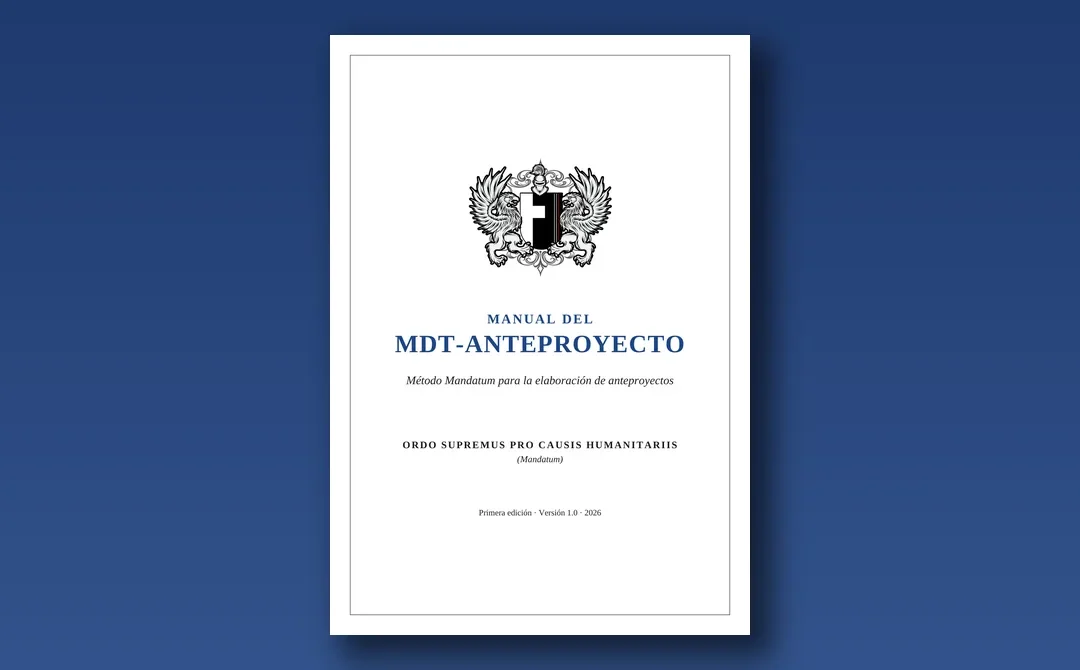
With 420 pages, the MDT-Anteproyecto manual unifies how each of the Order’s preliminary projects is prepared, presented and verified.
420pages
31chapters
8parts
7annexes
The MDT-Anteproyecto at a glance
PreparationInitial information · Research · Verification · Sizing of the project (Part II)
▼
1Executive Summary and Transformative VisionPart III · Ch. 10–12
2Next StepsPart IV · Ch. 13–16
3Modus OperandiPart V · Ch. 17–21
4BudgetPart VI · Ch. 22–26
▼
Design and deliveryStandard format · File naming · Final quality control and approval (Part VII)
Foundations of the Method (Part I) and governance of the Method (Part VIII) frame the whole process.
The Academy of Humanitarian Project Management of Mandatum has approved the first edition of the Manual of the MDT-Anteproyecto, which gathers the Mandatum Method for the preparation of preliminary projects (anteproyectos). The work runs to 420 pages, with 31 chapters organized in eight parts, seven annexes and a verification record.
One method for every preliminary project
The purpose of the manual is that any member of the team, with the right training, can prepare a preliminary project to the quality the Order requires, without depending on the memory or personal judgment of whoever did the previous one. Two preliminary projects prepared by different people in different countries will thus share the same structure, the same rigor and the same appearance.
With these 420 pages, the Academy now has an invaluable procedures manual to unify the method, the presentation, and the verification and control of all the Order’s preliminary projects.
How it is organized
The manual follows the order in which the work is done, not the order in which the documents are read. Its eight parts run as follows:
Foundations of the Method (5 chapters)
Preparation (4 chapters)
Document 1: Executive Summary and Transformative Vision (3 chapters)
Document 2: Next Steps (4 chapters)
Document 3: Modus Operandi (5 chapters)
Document 4: Budget (5 chapters)
Design and Delivery (4 chapters)
Work Organization and Governance of the Method (1 chapter)
The seven annexes gather the working tools: the Initial Information Form, the templates for the four documents, the evidence catalog, the formulas, a complete worked example, the control forms and a guide to the oral presentation of the preliminary project. A verification record of the manual closes the work.
The Method rests on the Integrated Financial Resources System (SIRF), developed by Pimas and Riera (2026).
Next step
ERUDI will soon create Course 201 of the Academy, to instruct and train the members of the Order who devote themselves to this work.
This outlet will continue to report on the Academy’s work.
 Barça
 Peñarol
 Inter Miami