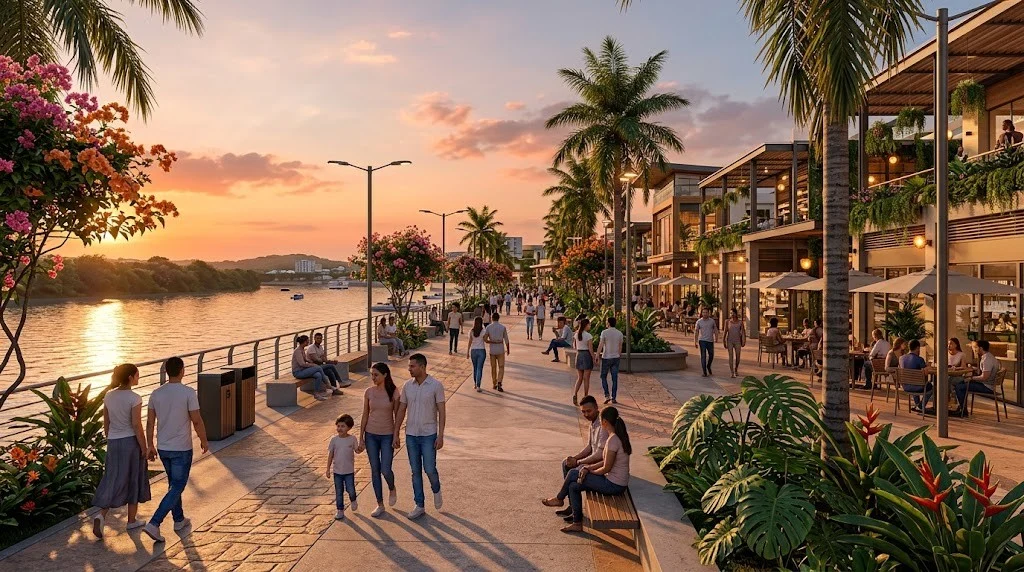
Cover image: 3D render (AI-generated illustration, not a photograph).
This week, a delegation from Mandatum held a meeting with the Honorable Representative for Chocó in Colombia’s House of Representatives, Astrid Sánchez, to learn first-hand about the challenges of planning and urban order in her department and the priorities she considers important for possible development projects. The delegation was led by Jeison Giraldo, Chancellor of Mandatum for Colombia, accompanied by his counterpart Juan Diego Herrera Gutiérrez, Chancellor of Mandatum for Panama.
At a glance
Meeting with the Honorable Representative Astrid Sánchez (Chocó), held this week on behalf of the Order. Main topics: a waterfront promenade with commercial spaces, and organized areas for street vendors. Status: information-gathering only; no project has been defined. Next, the Order will present a preliminary project for the authorities to evaluate.
What was discussed
Two ideas to organize the city
Chocó, on Colombia’s Pacific coast, faces real difficulties in territorial planning, especially in its urban areas. The conversation focused on how better order in public space could open room for gathering, commerce and community life. Two ideas were mentioned.
01
A waterfront promenade
An urban space with commercial premises that helps organize the city and creates places for meeting and economic activity for the community.
02
Organizing informal commerce
Street vendors currently occupy pedestrian walkways. The idea: organized commercial zones where they can work in better conditions.
A city that is orderly, safe and open to local entrepreneurs is a city where families can thrive.
Why it matters
Beyond housing: building complete communities
Safe, well-planned cities
These ideas fit the work of the Order, which looks at the development of safe urban communities where homes are accompanied by commercial spaces, services and infrastructure that favor everyday well-being.
Local micro-enterprise
Organized commercial zones can become a platform for local micro-entrepreneurs, supported with funding and training, so that vendors can grow stable livelihoods rather than work on the margins of the city.
Work and education
A community is more than its buildings. The Order also seeks to bring work and education to the communities it serves, so that progress reaches people and not only places.
The road ahead
From conversation to proposal
The topics raised will be taken into account during the analysis and structuring of preliminary proposals. Any proposal will arise from a comprehensive evaluation of the territory’s real needs, its feasibility and its impact on communities. The next step is for the Order to present a preliminary project (anteproyecto) to the authorities, so they can evaluate whether it fits the needs of Chocó. Their feedback will guide any further work.
ListenMeet the authorities and hear their priorities directly. (this week)
Gather informationCompile the needs, locations and constraints that were shared.
Analyze and structureStudy each territory technically and shape preliminary proposals.
EvaluateAssess needs, viability and community impact before anything is presented.
Present to the authoritiesThe Order submits a preliminary project (anteproyecto) so they can evaluate whether it fits the needs of Chocó.
With gratitude
The Order expresses its sincere gratitude to the Honorable Representative Astrid Sánchez for receiving the delegation, for the time she generously dedicated to the meeting, and for openly sharing the needs and priorities of the people of Chocó. We deeply value her trust and her commitment to her department, and we look forward to continuing this respectful dialogue.
Source: institutional report by Jeison Giraldo, Chancellor for Colombia of the Order. The topics above reflect only the information and interests shared during the meeting and do not represent a decision on any project.
Preliminary and non-binding. Figures are orders of magnitude subject to studies. Nothing advances without consensus.
The Chancellor of Mandatum in Panama, Juan Diego Herrera Gutiérrez, met with leaders of the Ngäbe-Buglé and Naso Tjër Di nations to discuss the Order’s proposal for the district of Bocas del Toro, on Panama’s Caribbean coast. The Order proposes to study a first-class ecological tourism development, built together with the original peoples, the Ngäbe-Buglé and Naso Tjër Di nations, and not on top of them. As the proposal states, nothing advances without their prior, free and informed consent.
The proposal follows two principles: it must be ecologically sustainable from the start, and it must end up economically sustainable. Any surplus is reinvested in the project itself and in future works of the Order.
75.63%of the district is protected environmental land
24%the only area where building is proposed
5 × 150ecological hotels of about 150 rooms each
10 yearsfund sustaining the project until break-even
Without consensus, Mandatum withdraws
The precondition is agreement from the Presidency, the Municipality of Bocas del Toro and the traditional indigenous authorities of the Ngäbe-Buglé and Naso Tjër Di nations, with prior, free and informed consent. If there is no consensus, Mandatum withdraws. The Order fully recognizes the Ngäbe-Buglé and Naso Tjër Di nations and understands that it holds no sovereignty, which limits its role in governance; for that reason the project is also agreed with the national Government.
The territory
The protected land includes the Isla Bastimentos Marine National Park, and nothing would be built there. The area is home to indigenous peoples with recognized territories, the Ngäbe-Buglé and Naso Tjër Di comarcas, as well as the Afro-Caribbean and Creole population of the archipelago. Nearly half of households lack stable electricity, which drives mangrove cutting for firewood.
What the Order proposes
Partnership with the landowner. The landowner partners with Mandatum instead of being displaced, and the Ngäbe-Buglé and Naso Tjër Di nations would take part as development partners.
First-class tourism. The preliminary concept envisions 5 ecological hotels of about 150 rooms each, up to three floors and powered 100% by renewable energy, built by Mandatum under leading global hotel brands. Access would include a marina, boats and electric vehicles, and a private airport if feasible.
Cruise-style package. Tourists buy a package with spending credits that they redeem at restaurants, ice cream shops, tours and local shows run by formal community businesses. Each business receives the money corresponding to the tourist’s choice.
Worldwide marketing. A large international promotion budget is a condition for the model to work.
The community as protagonist. A training center in hospitality, gastronomy, management and tourism service; incubators with seed capital so the community can open formal businesses; priority for local hiring in the hotels; and a museum of the indigenous nations with a program promoting their culture, history and products nationally and internationally.
Housing, health and essential services. Homes for hotel staff, firefighters, police, teachers, nurses, doctors and the general population, and a hospital for the population and the indigenous nations.
Mandatum would equip and train firefighters, police and essential services to a first-class standard, but would not control them. They would remain in the hands of the indigenous nations or the competent government, and before any start an agreement must be signed to sustain them through taxes, with decent salaries, equipment in perfect condition and constant training.
Mangroves: Territorio Azul
The environmental component is the program Bocas del Toro – Territorio Azul, by Carbono & Bosques (Grupo 4C): mangrove conservation and restoration and blue carbon, with local park rangers and independent monitoring, aligned with the MiAMBIENTE agenda. Blue carbon revenue is treated as complementary and is not counted in the financial model until secured.
Casino and financial sustainability
A casino, subject to study, would operate for foreigners only, as in the Bahamas. Neither members of the indigenous nations nor Panamanian citizens could gamble, and a large share of its revenue would go to the indigenous nations to sustain services and the hospital. A fund would also be created to sustain the project, including marketing, for 10 years, until break-even.
Institutional presence
The Order would have Mandatum Panamá in Panama City, and Mandatum Ngäbe-Buglé and Mandatum Naso Tjër Di in the territory. Over time, members of both nations would join Mandatum, and Mandatum would become integrated into them, as it is in the United States, Colombia, Peru and Suriname. Mandatum does not replace the State or use the power of force.
Pending before the preliminary design
Identify the landowner and define the form of partnership.
Integrate the Territorio Azul program with Carbono & Bosques.
Confirm with the traditional authorities of the Ngäbe-Buglé and Naso Tjër Di nations their participation as partners.
Identify sites within the buildable 24% and verify the legal regime of comarca lands.
Study the feasibility of the private airport.
Confirm whether Panamanian law allows a casino exclusively for foreigners.
Carry out a carrying-capacity study validated by the environmental authority and a 10-year financial viability study.
For members of the Order
Members who sign in with their @emandatum.com account can download the executive summary of this proposal (PDF, in Spanish, 2 pages).
Access is restricted to Order accounts. Other readers will be asked to sign in and will not be able to see the file.
This project also has a detailed technical document (investment costs, break-even point, maintenance, financing and ownership) available to members of the Order, who may request it from the Chancellery of the Order in their country.
A cordial call with the Minister of Public Housing, Spatial Planning, Environment and Infrastructure of Sint Maarten has opened a door that the Order welcomes with enthusiasm and gratitude.
Mr. Patrice T. Gumbs, Minister of Public Housing, Spatial Planning, Environment and Infrastructure of Sint Maarten, held a call with Mandatum. Taking part on the Order’s side was Ramses Bislick, a friend of the Order who works closely with Edgar Croes, the Chancellor of Mandatum before the Kingdom of the Netherlands.
Mr. Croes’ remit covers the whole Kingdom, including Sint Maarten, which is one of its constituent countries.
After the call, Mr. Bislick wrote to the Minister. He thanked him for the time and availability he had given to the conversation, and for introducing Mr. Gerald DeJong. In the same message he put all the parties in touch with one another.
Those in contact
Patrice T. Gumbs
Minister of Public Housing, Spatial Planning, Environment and Infrastructure, Sint Maarten
Gerald DeJong
Introduced by Minister Gumbs
Dimar Labega
Member of Parliament of Sint Maarten
Edgar Croes
Chancellor of Mandatum before the Kingdom of the Netherlands
Ramses Bislick
Friend of the Order, working closely with Chancellor Croes
An island the Order wishes to reach
For Mandatum, being present on the beautiful island of Sint Maarten would be a source of pride. The Order is a humanitarian organization, and what it hopes for the island is concrete: that its people can become part of the Order and that, together, they can develop a project that makes a before and an after in the lives of its citizens.
That is the heart of the conversation. It is not about an institutional presence for its own sake, but about a project with real impact for those who live on the island.
The Minister’s portfolio — public housing, spatial planning, environment and infrastructure — deals with the everyday conditions in which the island’s citizens live. The Order has not announced what the project would be, and none has been defined yet.
Direct dialogue between the parties
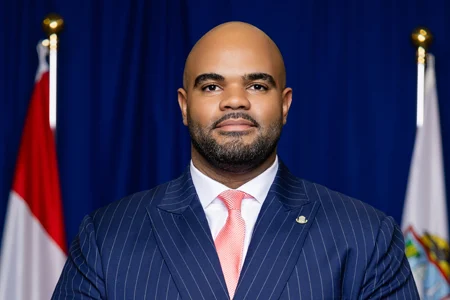
Minister Patrice T. Gumbs. Photo: Government of Sint Maarten.
During the call it was proposed, and Minister Gumbs agreed, that communication should take place directly between the legal entities representing the parties: Mandatum, on one side, and the island of Sint Maarten, on the other. It is considered the most convenient way forward.
Copied on the message were Mr. Dimar Labega, Member of Parliament of Sint Maarten, and Mr. Edgar Croes, Chancellor of Mandatum before the Kingdom of the Netherlands.
“Let us all be part of this great opportunity for the island of Sint Maarten.”
Ramses Bislick
What comes next
For now, these are exploratory conversations. They are non-binding: they do not commit either side and do not yet amount to an agreement or a defined project.
The next step is for the legal entities of Mandatum and of the island to open their direct channel and begin to explore what a joint project could look like. This outlet will continue to report as the dialogue develops.
This project does not yet have a detailed technical document (investment costs, break-even point, maintenance, financing and ownership). When it is ready, it will be made available to members of the Order here, on this outlet.
This week, a delegation from Mandatum held a meeting with the Honorable Governor Dilian Francisca Toro, head of the government of the Department of Valle del Cauca, to hear first-hand the territory’s main needs and the priorities of her administration for possible development projects. The delegation was led by Jeison Giraldo, Chancellor of Mandatum for Colombia, accompanied by his counterpart Juan Diego Herrera Gutiérrez, Chancellor of Mandatum for Panama.
At a glance
Meeting with the Honorable Governor Dilian Francisca Toro (Valle del Cauca), held this week on behalf of the Order. Main topic: housing needs after the earthquake, with Buenaventura as a key case. Status: information-gathering only; no project has been defined. Next, the Order will present a preliminary project for the authorities to evaluate.
What was discussed
Three concerns, one territory
Valle del Cauca is one of Colombia’s most dynamic departments, and Buenaventura, its Pacific port, is among the country’s most strategic cities. The Governor shared her concern about the effects of the earthquake, singling out Buenaventura because of its great importance as a port. From the conversation, three themes emerged.
01
Housing needs
Interest in helping families affected by the earthquake through housing solutions in specific neighborhoods, according to the needs identified on the ground.
02
Where homes are needed
Some homes may be required in particular areas, which could mean scattered solutions rather than one concentrated community or urban project.
03
Safety conditions
Security challenges in some areas of Buenaventura were mentioned, something to weigh carefully before any intervention is considered.
Listening first: no project is defined until the real needs of the territory are understood.
Why it matters
Housing is only the beginning
People before plans
After a natural disaster, the first urgency is a safe roof for families. But recovery also depends on what surrounds the home: access to work, schools, services and a sense of security. That broader view is where the Order’s experience in community development becomes relevant.
Scattered, not concentrated
The Governor’s remark that homes may be needed in specific sectors matters. It suggests that a single large development may not fit every case, and that each solution must respond to the neighborhood where families already live.
Safety as a design condition
Security was raised as a real constraint in parts of Buenaventura. Any future proposal would need to assess it from the start, alongside technical feasibility and the expected impact on communities.
The road ahead
From conversation to proposal
The topics raised will be taken into account during the analysis and structuring of preliminary proposals. Any proposal will arise from a comprehensive evaluation of the territory’s real needs, its feasibility and its impact on communities. The next step is for the Order to present a preliminary project (anteproyecto) to the authorities, so they can evaluate whether it fits the needs of Valle del Cauca. Their feedback will guide any further work.
ListenMeet the authorities and hear their priorities directly. (this week)
Gather informationCompile the needs, locations and constraints that were shared.
Analyze and structureStudy each territory technically and shape preliminary proposals.
EvaluateAssess needs, viability and community impact before anything is presented.
Present to the authoritiesThe Order submits a preliminary project (anteproyecto) so they can evaluate whether it fits the needs of Valle del Cauca.
With gratitude
The Order expresses its sincere gratitude to the Honorable Governor Dilian Francisca Toro for receiving the delegation, for the time she generously dedicated to the meeting, and for openly sharing the concerns and priorities of the people of Valle del Cauca. We deeply value her trust and her commitment to the families of her department, and we look forward to continuing this respectful dialogue.
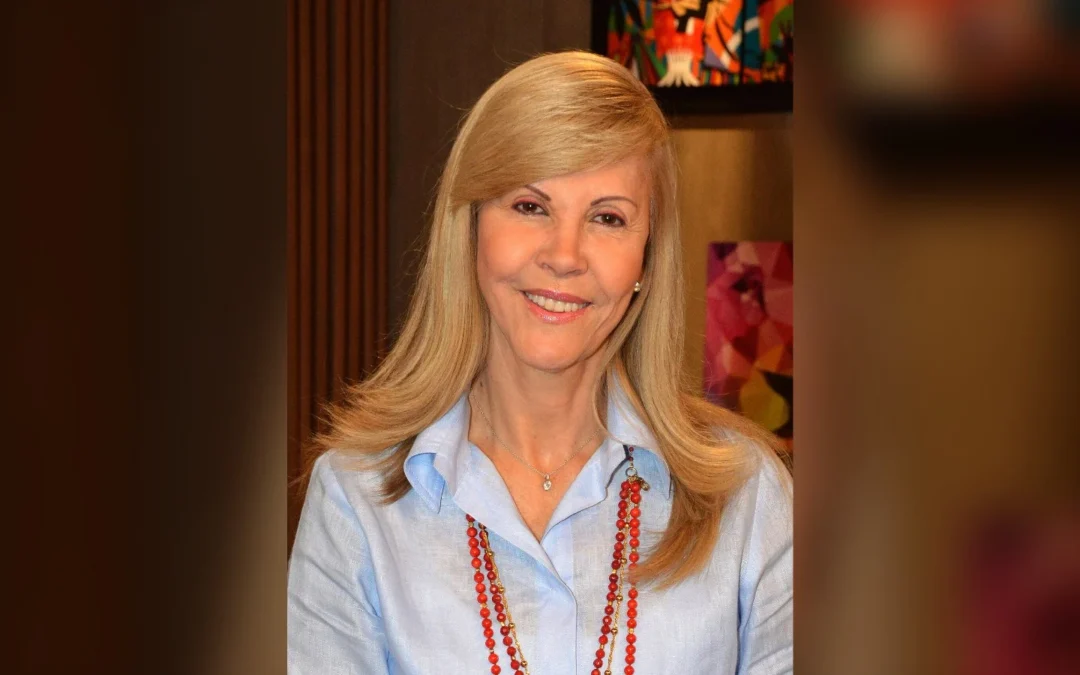
Source: institutional report by Jeison Giraldo, Chancellor for Colombia of the Order. The topics above reflect only the information and interests shared during the meeting and do not represent a decision on any project. Photo: Lacrodriguezm, Wikimedia Commons, CC BY-SA 4.0 (cropped).
Most account break-ins do not involve clever hacking. They start with a reused password, an old app or a convincing message. The US Cybersecurity and Infrastructure Security Agency (CISA) summarizes good digital hygiene in four actions, and all of them are free.
1. Use more than one way to prove who you are
Turn on multi-factor authentication on every account that offers it. After your password, the service asks for a second proof: a code sent by text, an authenticator app, a fingerprint or face scan, or a physical security key. If someone steals your password, they still cannot get in.
2. Keep your software updated
Install updates for your phone, computer, apps and browser. Updates often close security holes that criminals already know about. The easiest way is to switch on automatic updates.
3. Think before you click
Be careful with unfamiliar links, especially in email and messages. Phishing pages can look exactly like the real thing and are built to steal passwords, card numbers and other sensitive data. If a message creates urgency, go to the website yourself instead of using the link.
4. Use strong, unique passwords
Each account should have its own password, never reused. Mix letters, numbers and symbols, and make passwords long. Because nobody can remember dozens of them, consider a password manager, which creates and stores them for you.
One more rule
Never share a verification code that arrives by text or in a messaging app, even with someone who seems to be a friend or a company. A code is meant for you alone.
Source: CISA, “Four Things You Can Do To Keep Yourself Cyber Safe.” Image: padlocks on a fence, via Wikimedia Commons (CC0).

 Barça
 Peñarol
 Inter Miami