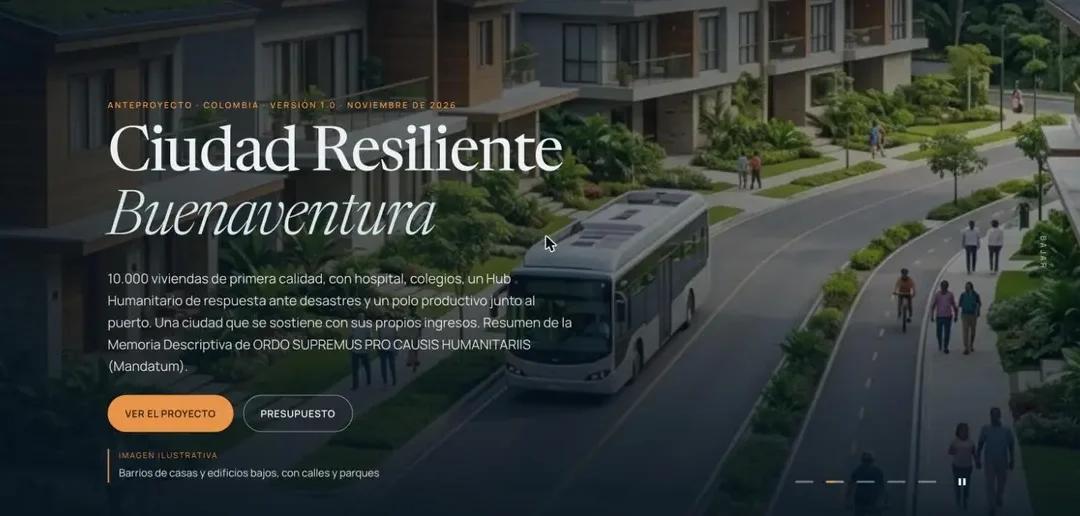
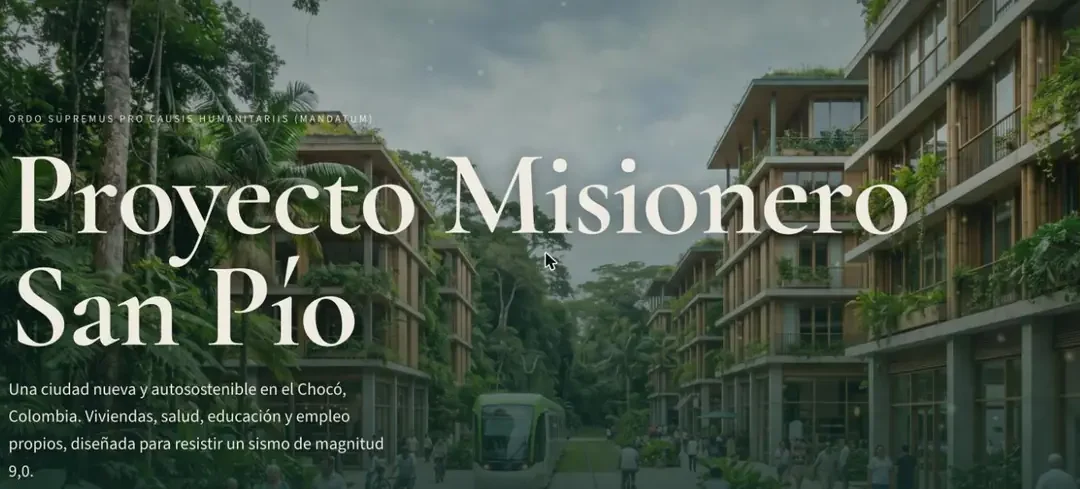
The Ciudad Resiliente Buenaventura (Resilient City of Buenaventura) now has its own website, bv.emandatum.com. It presents the Ordo Supremus Pro Causis Humanitariis preliminary project for a proposed new city of 10,000 homes on Colombia's Pacific coast, with a hospital, schools, a Humanitarian Hub and a productive hub by the port. This is a tour of what it shows.
10,000
Homes
150
Hospital beds
US$3,794.3M
Total cost
106 months
Full city
01
The need
A quake, and thousands of families without housing
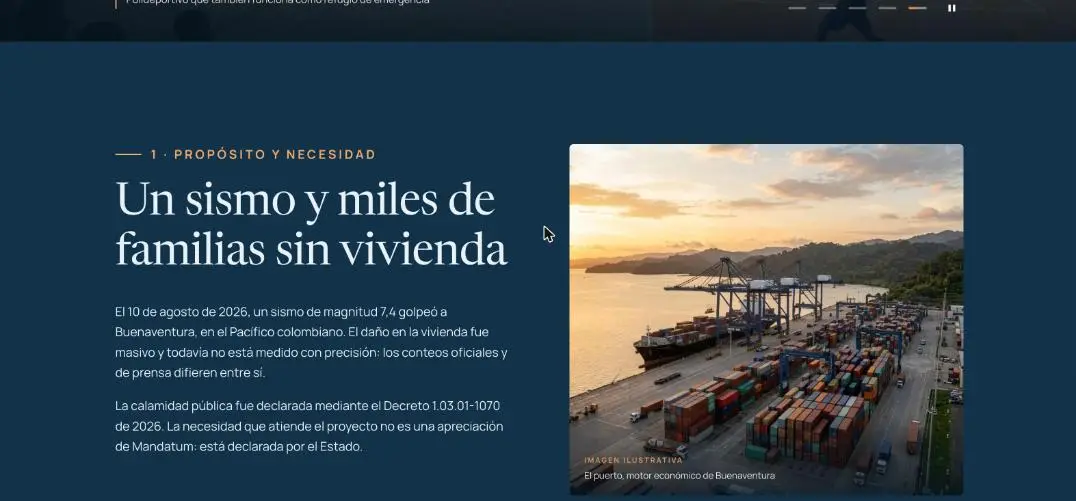
The site starts from an event: a magnitude 7.4 earthquake that struck Buenaventura on August 10, 2026. Damage to housing is large but not yet precisely measured, and official and press counts differ. The public calamity was declared under Decree 1.03.01-1070 of 2026, and the final number of families will be set by the RUFE registry.
Note
The need is not Mandatum's own assessment: it is declared by the State.
The proposal is a complete new city, with no debt, no guarantee and no fiscal cost to Colombia. It sets five goals: 10,000 homes in two phases of 5,000; health, education and disaster-response services open to the wider population; jobs through a port-linked productive hub; operations that fund themselves; and payments tied to certified works.
bv.emandatum.com
The first section: the earthquake and the declared need.
02
The land
The most important port, with little land available
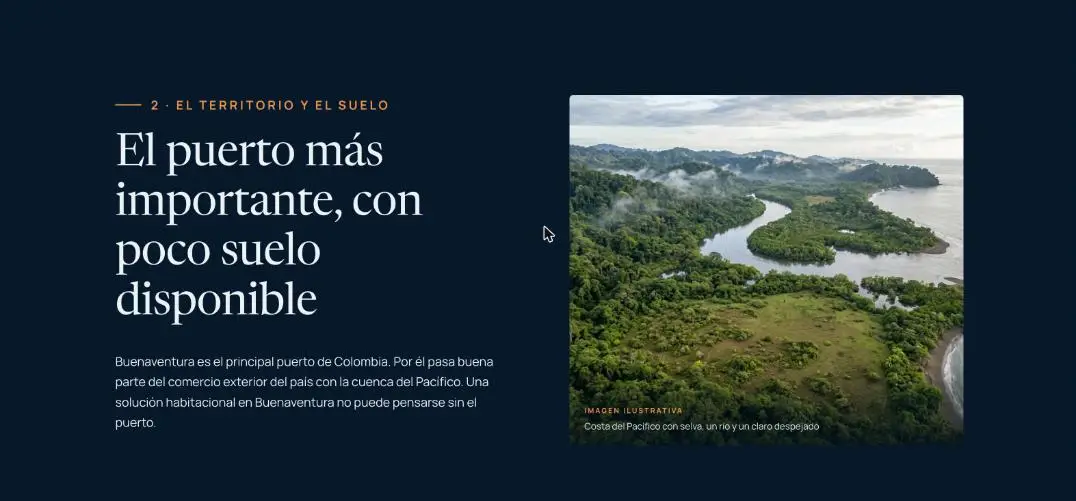
Buenaventura is Colombia's main port, yet most of its land is legally protected, the city depends on a single road to the interior, and it faces earthquake, tsunami and flood threats. That is why the project looks for new land outside the coastal strip, in Valle del Cauca.
How land is obtained
Bought from private owners or through agreements with community councils, with consent and prior consultation where required.
Price
Never above the commercial appraisal. The budget assumes 100 million pesos per hectare, to be checked against official appraisals.
Decision point
The final site is chosen at Gate B and registered to Mandatum's local entity.
bv.emandatum.com
The territory: the country's main port, with little usable land.
03
The concept
A new city, not a housing estate
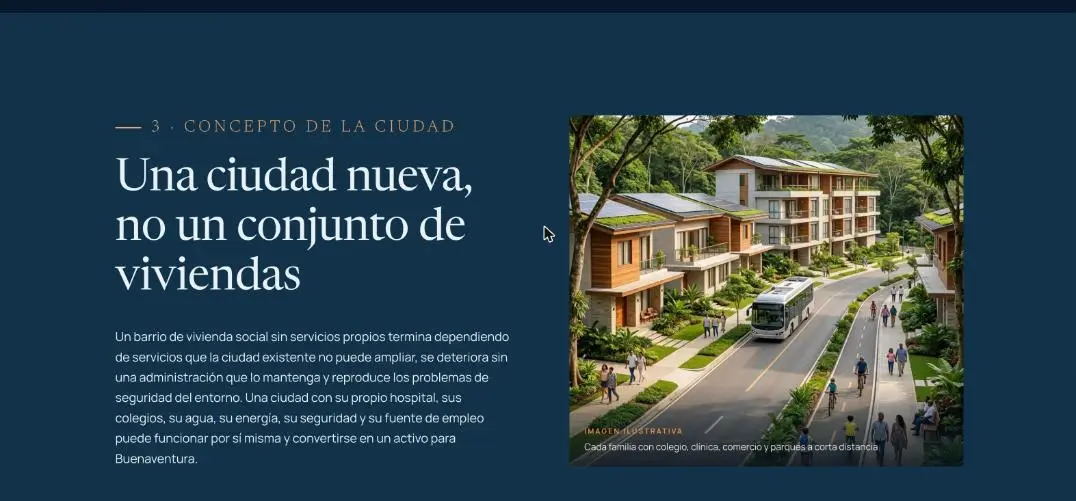
The city is designed, contracted and run as one: a single master plan, a single General Contractor and a single administration. It is built in four neighborhoods of 2,500 homes each, with phase 1 covering neighborhoods 1 and 2 and phase 2 covering 3 and 4.
“A city with its own hospital, schools, water, energy and jobs can stand on its own.”
1,500 ha
Land
678 ha
Urban area
822 ha
Reserve
35,000
People (est.)
Six design principles
Premium quality, lower long-term operating costs, resilience to disasters, self-sustainability, permanent ownership and management, and respect for communities.
Each neighborhood
750 two-bedroom apartments (90 m²), 1,250 three-bedroom houses (110 m²) and 500 four-bedroom houses (130 m²). The mix is an assumption, to be adjusted with RUFE data.
bv.emandatum.com
The concept: one city, one master plan, one administration.
04
The components
Each component, with its function and its cost
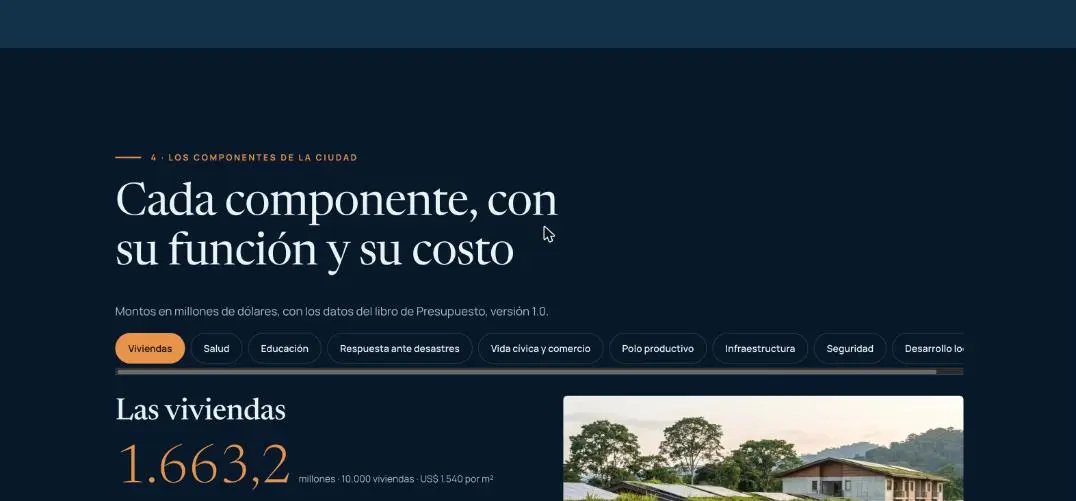
The site walks through the pieces one by one, with amounts in US$ millions. Housing is the largest: US$1,663.2 million for 10,000 homes at US$1,540 per square meter, built to the NSR-10 seismic code. The homes are not sold, and rent is capped at 33% of household income.
Health and education
150 hospital beds and four neighborhood clinics; 4,000 school places plus 1,500 technical and university places.
Humanitarian Hub
A multipurpose hall and logistics yard, designed to keep working after an earthquake.
A productive hub
About 200,000 m² of logistics warehouses (US$120.0M), 20,000 m² of cold storage (US$30.0M), 300,000 m² of container yards, a 30,000 m² services campus and a 9,000 m² hotel zone. Demand is still to be confirmed by a market study.
Its own services
A solar plant of about 70 MW with storage (US$84M) and a water and wastewater plant (US$40M).
Security
A mainly electronic system with a 24-hour control center, coordinated with the National Police and paid from company rents, not from family rent.
bv.emandatum.com
Each component of the city, with its cost.
05
The families
Who receives each home, and how it is decided
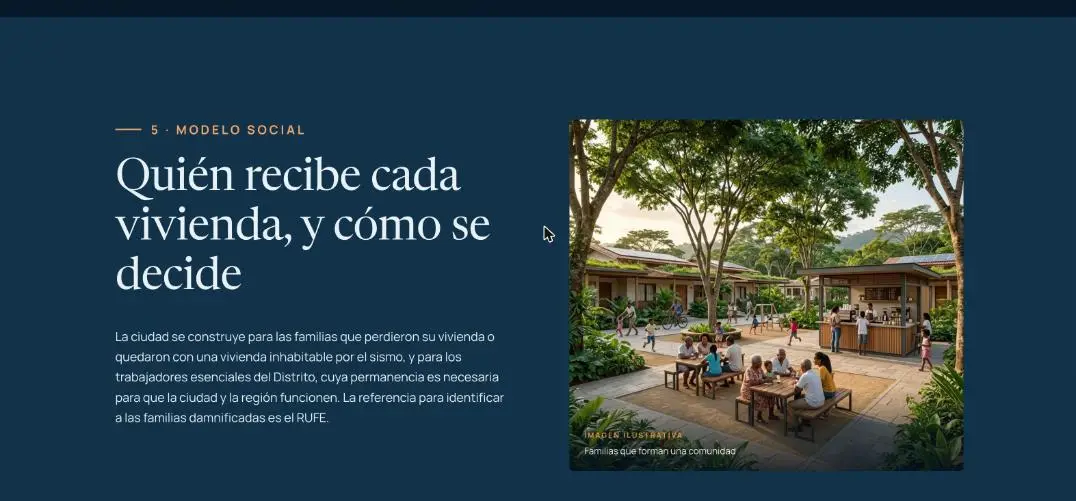
Homes go to families who lost theirs or were left with an uninhabitable one, and to essential workers of the District. Allocation follows a regulated, public process run by an Adjudication Commission, whose composition and criteria are fixed in regulations approved before the first handovers.
The housing contract
Rent capped at 33% of income, with a floor of about 578,000 pesos a month; one income check per year; no sale, subletting or subdivision.
Communities
No displacement of ethnic communities, with prior consultation and agreements signed before any land is bought.
Local work
Hiring preference for local people, with on-site training.
Open point
The Governorate has suggested dispersed housing, which differs from this concentrated-city proposal. The two approaches must be reconciled with the Governorate and the District.
bv.emandatum.com
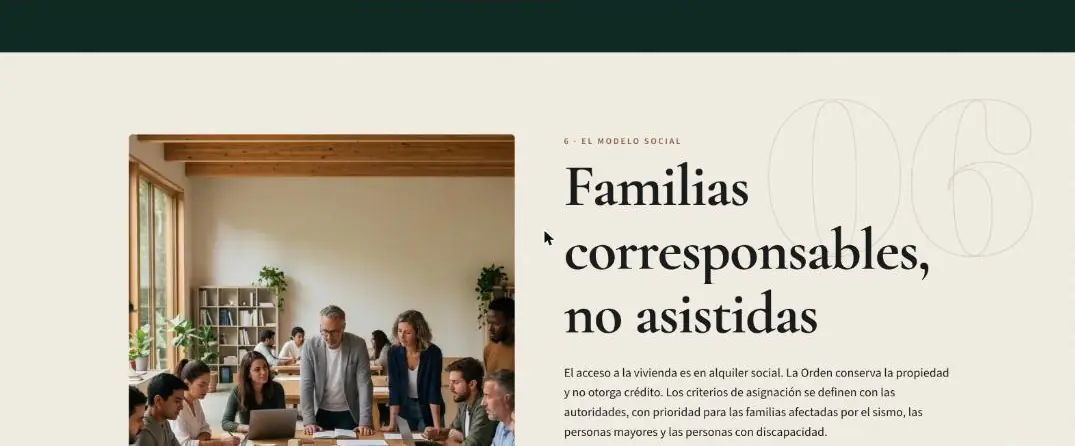
The social model: who receives each home.
06
Operation and environment
A city that pays for itself
After construction, at Gate D, Mandatum's local entity owns and runs the city permanently. Revenue comes from rents, company rents, water and energy sales and services, and any surplus is reinvested in the city.
US$110.0M
Sustainment fund
US$55.0M
For phase 1
170 ha
Green areas
~70 MW
Own solar
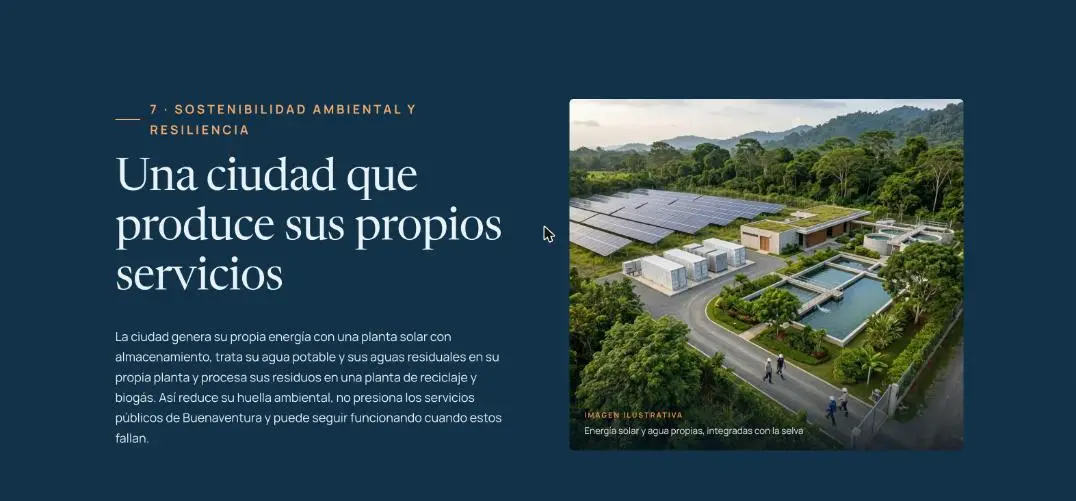
The fund covers early deficits. It is released quarterly against certified reports and paid directly to providers until the city breaks even. Environmentally, the city treats its own water and processes its own waste in a recycling and biogas plant.
bv.emandatum.com
The environment: solar energy and water of its own, set within the forest.
07
Financial integrity
The money never passes through the hands of those who manage it
Funds stay in custody accounts, split by Gate, and are paid directly to registered, verified suppliers. Neither the Order, its local entity nor the General Contractor receives funds to administer. Each payment follows seven steps, and no Gate is paid before the previous one closes.
The site names the independent actors: the technical certifier, the contractor, the custodian bank, the external auditor and the public counterparts. It acknowledges that the certifier is institutionally linked to Mandatum and lists five safeguards to offset that.
08
The budget
Total project cost: US$3,794.3 million
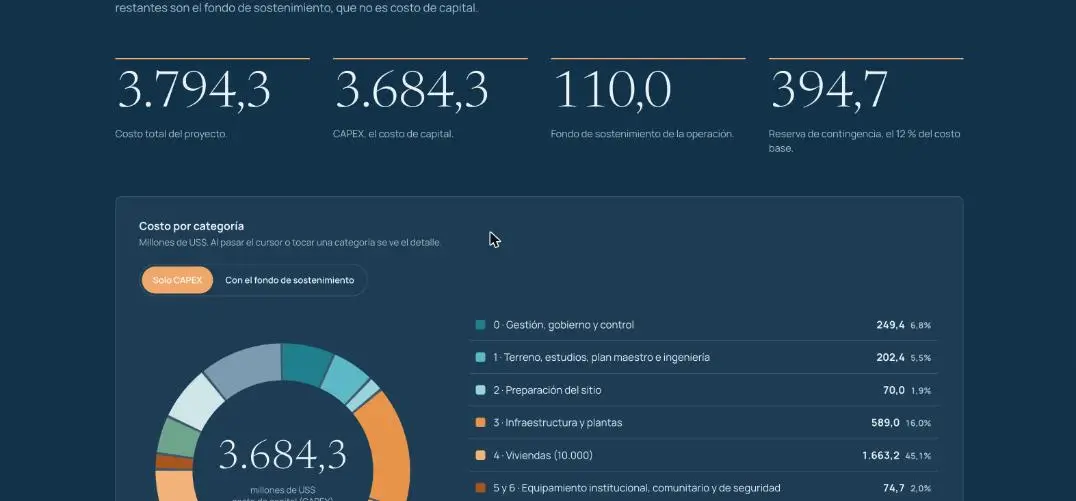
Of the total, US$3,684.3 million is capital cost and US$110.0 million is the sustainment fund, which is not capital cost. The contingency reserve is US$394.7 million, 12% of the base cost.
Largest capital-cost lines listed on the site
Housing (10,000 homes)US$1,663.2M · 45.1%
Infrastructure and plantsUS$589.0M · 16.0%
Management, governance and controlUS$249.4M · 6.8%
Land, studies, master plan and engineeringUS$202.4M · 5.5%
Institutional, community and security facilitiesUS$74.7M · 2.0%
Site preparationUS$70.0M · 1.9%
Share of capital cost (CAPEX, US$3,684.3M). Other lines are not shown here.
Phase 1
5,000 homes: US$2,112.3 million, 55.7% of the total.
The site is candid that the figure could change before Gate C, for example if the General Contractor's costs turn out not to include overhead, contingencies and profit.
bv.emandatum.com
The budget: total cost and its breakdown by category.
09
The schedule
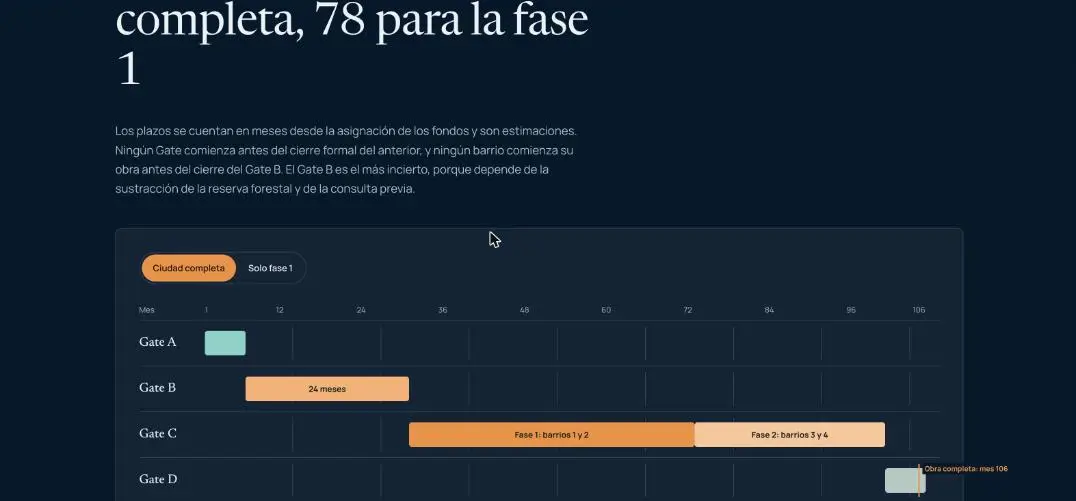
106 months for the full city, 78 for phase 1
Durations are estimates counted from the allocation of funds. Gate B is the most uncertain, since it depends on forest-reserve removal and prior consultation.
Four Gates, 106 months
A
B · 24
C · works, 70 months
D
A · 6 months activationB · 24 months design and landC · 70 months works (42 for phase 1)D · 6 months audit and handover
The page also lists ten main risks, each with probability, impact and response.
bv.emandatum.com
The four Gates on one timeline, for the full city.
10
The impact
Housing, health, education and work
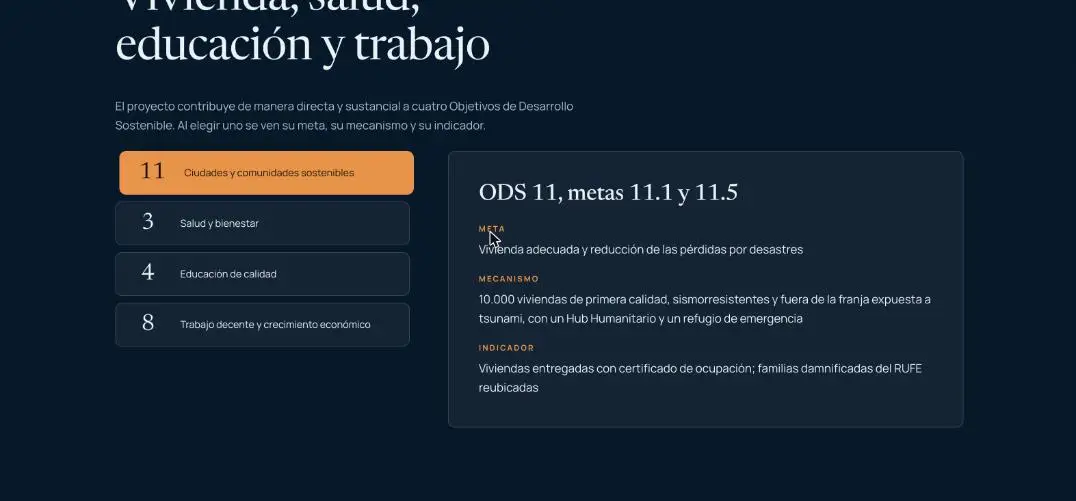
The site ties the project to four of the Sustainable Development Goals, each with a target, a mechanism and an indicator.
SDG 11
Cities
SDG 3
Health
SDG 4
Education
SDG 8
Work
It cites an estimated 35,000 residents, still to be confirmed, 4,000 people trained and about 1,000 entrepreneur loans. Direct jobs are not yet quantified in this version.
bv.emandatum.com
The impact: four goals, each with a target, a mechanism and an indicator.
Assumed
The page closes with thirteen assumptions and government decisions, all to be confirmed: the final family count, concentrated city versus dispersed solutions, the land, forest-reserve removal, unit costs, hub demand and timelines. It is a preliminary project, and it says so.
Visit the site
The full summary of the preliminary project, with the budget, the schedule and the risk table, is at bv.emandatum.com.
A note on the images. The photographs on the site are concept illustrations, not final designs or real works, and the summary is informational: the technical documents govern.
This project also has a detailed technical document (investment costs, break-even point, maintenance, financing and ownership) available to members of the Order, who may request it from the Chancellery of the Order in their country.
On 18 November 1803, just south of Cap-Français in what was then Saint-Domingue, the army of Jean-Jacques Dessalines faced French forces commanded by General Donatien de Rochambeau. The battle of Vertières ended in a rebel victory.
The road to Vertières
The revolution had begun in 1791. Its best-known leader, Toussaint Louverture, was arrested by the French in 1802 and died in French captivity in April 1803. Dessalines, one of his generals, took command, and the fighting resumed with the former colony's army and many of its people united against the French.
The battle and its aftermath
François Capois, whose courage under fire became legendary in Haitian memory, was among the commanders. Rochambeau withdrew under cover of a storm and, the next morning, sent a representative to negotiate. The terms gave the French ten days to leave the island.
Independence and remembrance
Dessalines proclaimed the independent nation of Haiti on 1 January 1804, making it the first independent state in Latin America and the Caribbean, and the first republic founded by formerly enslaved people. In Haiti, 18 November is widely commemorated as a day of victory.
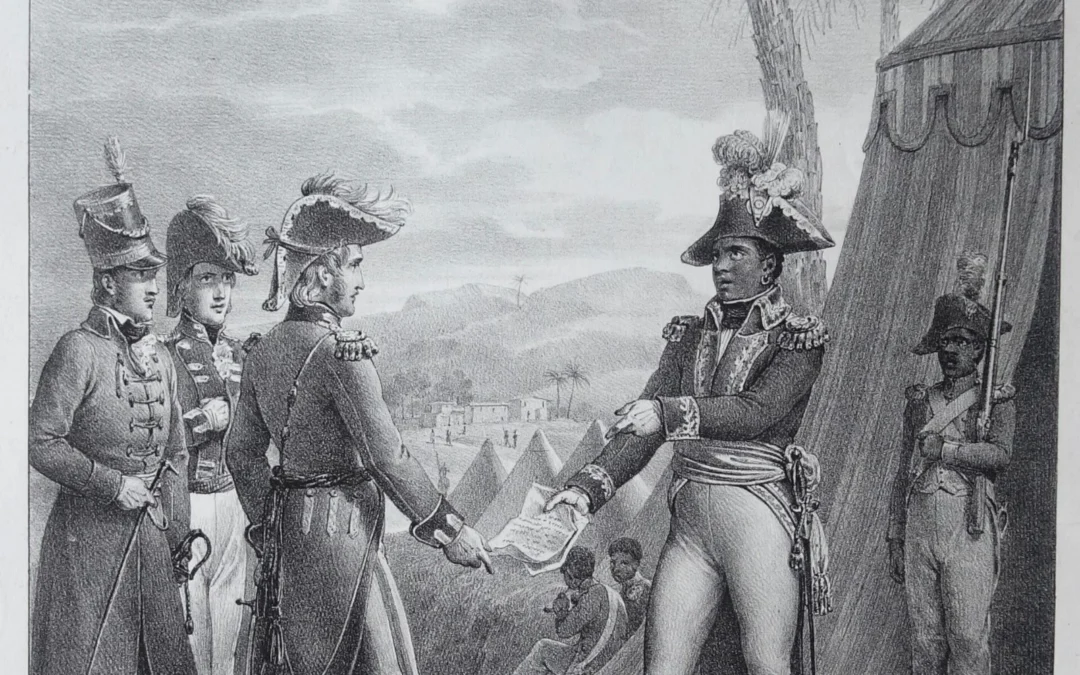
Image: Engraving of Toussaint Louverture receiving British General Thomas Maitland, 30 March 1798 (public domain), via Wikimedia Commons. It shows an earlier phase of the revolution, not the battle itself.
The Proyecto Misionero San Pío (San Pío Missionary Project) now has its own website, pio.emandatum.com. It presents the Ordo Supremus Pro Causis Humanitariis preliminary project for a new, self-sustaining city in Chocó, Colombia, designed to withstand a magnitude 9.0 earthquake. This is a tour of what it shows.
2,000 ha
Of city
20,000
Homes
70,000
Residents
102
Months
The site is written in Spanish and works as a reading guide: a menu with Need, Concept, Components, Social model, Cost, Schedule, Impact and Assumptions, and a contact button always in view. The Order's contacts in the region were covered earlier in Mandatum's meeting with a Chocó representative; here the whole preliminary project can be read in one place.
The need
A need declared by the State
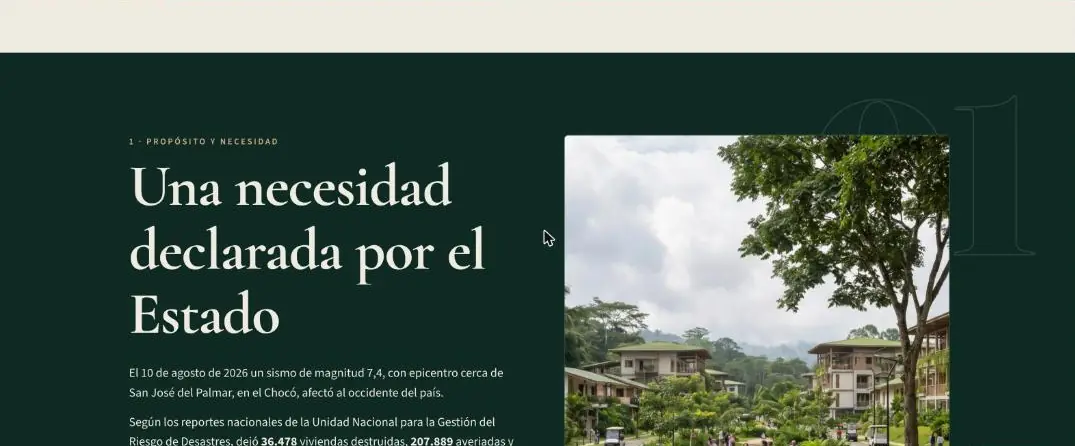
The site starts from an event: a magnitude 7.4 earthquake on August 10, 2026, with its epicenter near San José del Palmar, in Chocó. According to the national risk management unit's reports, it left 36,478 homes destroyed, 207,889 damaged and 364,664 families affected, and the site adopts the highest figure when sources differ. It also says there is no Chocó-specific breakdown yet, so the housing program is treated as an assumption. The government has responded with Decrees 1261 and 1348 of 2026 and Legislative Decree 1422 of September 17, 2026.
pio.emandatum.com
The first section: the earthquake and the national figures. Photos on the site are concept images.
The land
A rule that admits no exceptions
Rule 1
No collective land
Land is not bought from collective territories, indigenous reserves (resguardos) or communities.
Rule 2
No one displaced
No person is moved, and ecological or protected areas are not used.
Rule 3
A buildable site
The lot must be buildable and not flood-prone.
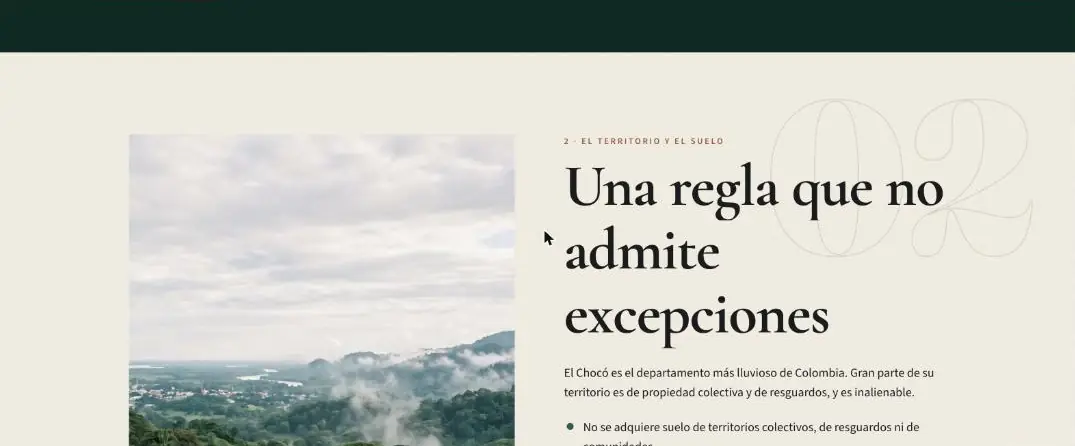
Chocó is Colombia's rainiest department, and much of its land is collective and inalienable. The city needs 2,000 hectares, plus a 1,000-hectare reserve that would grow crops under an agroforestry scheme until it is needed. The site states the consequence plainly: if no site meets these conditions, the project will not be built in Chocó.
pio.emandatum.com
The land rule, shown over the Chocó landscape.
The concept
Six principles, three phases
I
One housing standard
60 m² for every family.
II
Extreme seismic resilience
Designed for magnitude 9.0, with base isolation for critical buildings.
III
Local jobs
Created by the city's own employment engines, whether or not outside companies arrive.
IV
Energy and water
The city generates its own solar power and treats its own wastewater.
V
Low maintenance
Higher initial quality in exchange for lower recurring costs.
VI
Permanent administration
Mandatum's local entity keeps managing the city.
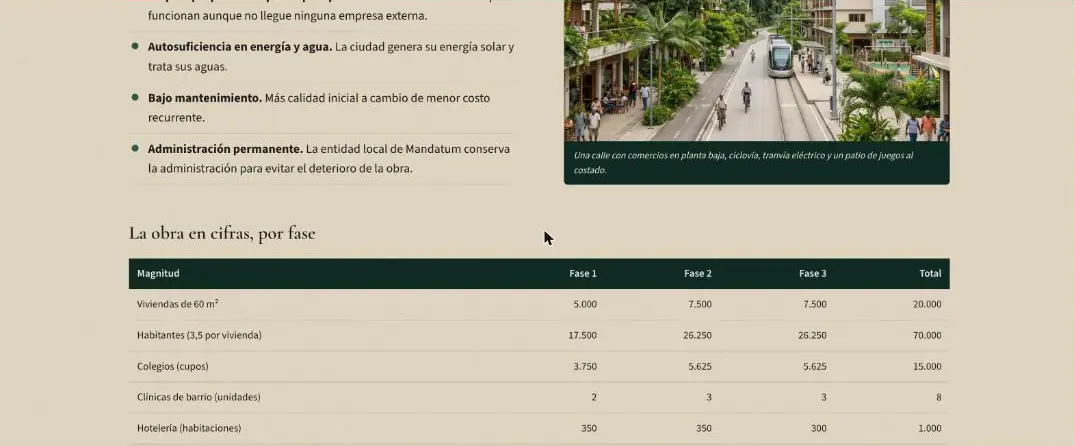
The works are built in three phases of 5,000, 7,500 and 7,500 homes, for a total of 20,000 homes and 70,000 residents. The totals also include 15,000 school places, eight neighborhood clinics, 1,000 hotel rooms and a 60 MW solar plant. Each phase must sustain itself, and the third goes ahead only if the first two reach over 90% of their projected jobs and income.
pio.emandatum.com
The works in figures, phase by phase.
The layout
2,000 hectares, eight uses
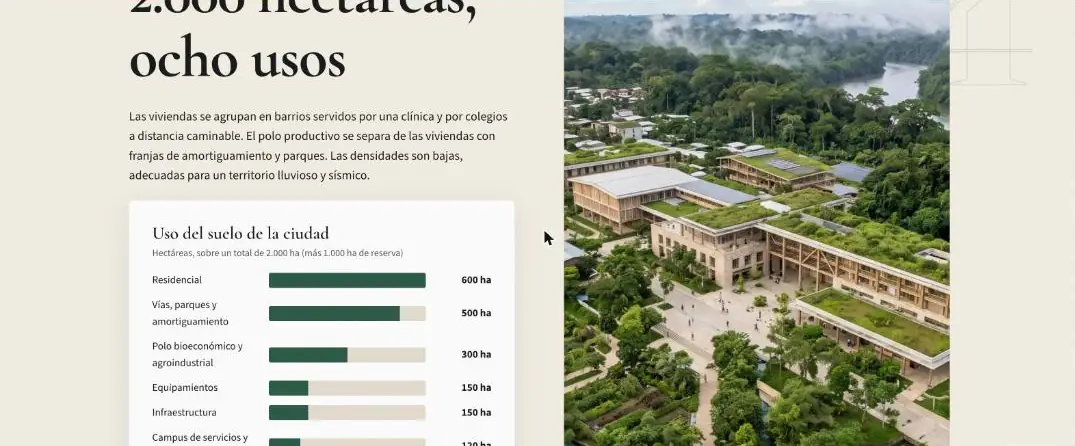
Homes are grouped into neighborhoods, each with a clinic and schools within walking distance. The production hub is kept apart from housing by buffer strips and parks, and densities are low, which suits a rainy and seismic territory. The largest uses are residential (600 hectares) and roads, parks and buffer areas (500 hectares), followed by a bioeconomic and agroindustrial hub (300 hectares). The site says its model is schematic and is not the master plan.
pio.emandatum.com
Land use across the 2,000 hectares.
The people
Families who share responsibility
Housing is offered through social rental: the Order keeps ownership and grants no credit. Priority goes to families affected by the earthquake, older people and people with disabilities, with criteria set together with the authorities. A local development program backs it with US$ 50.0 million for social harmonization and training, a US$ 10.0 million revolving microcredit and training fund, and US$ 5.0 million for local tourism certification and training.
pio.emandatum.com
The social model: co-responsible families, not assisted ones.
The money
Funds do not pass through Mandatum
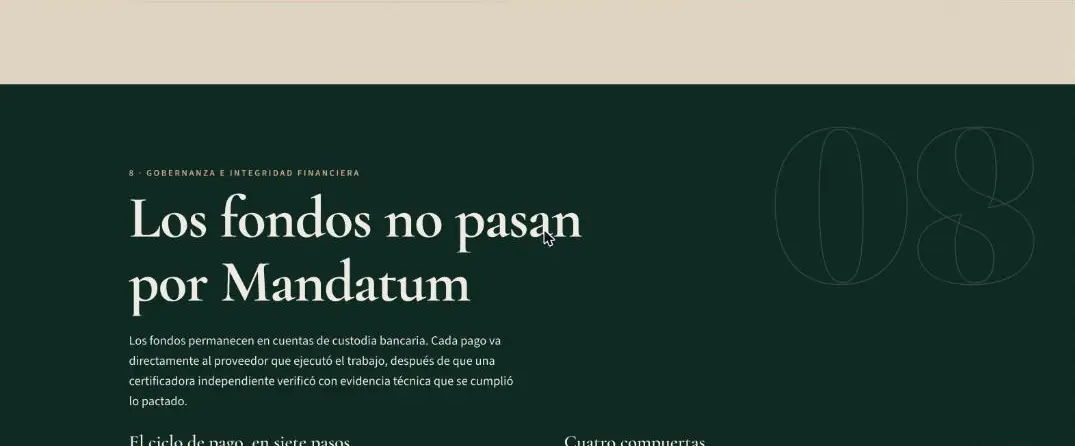
Funds stay in bank custody accounts, and each payment goes directly to the provider who did the work, after an independent certifier has checked the evidence. The project moves through four Gates, A to D, and none begins until the previous one is closed. Project management offices in Miami and Colombia, with 86 staff, run it, and no Order entity can issue certificates, authorize payments or override the auditor.
1
Work and evidence
2
Secure upload
3
Independent certification
4
Signed payment order
5
Settlement approval
6
Bank pays provider
7
Reconciliation and audit
pio.emandatum.com
The governance section: seven steps from work to payment.
The budget
Cost and schedule
Construction cost
US$ 5,437.0 million
Includes land, design, works, programs, management and a contingency reserve of US$ 1,163.1 million.
Schedule
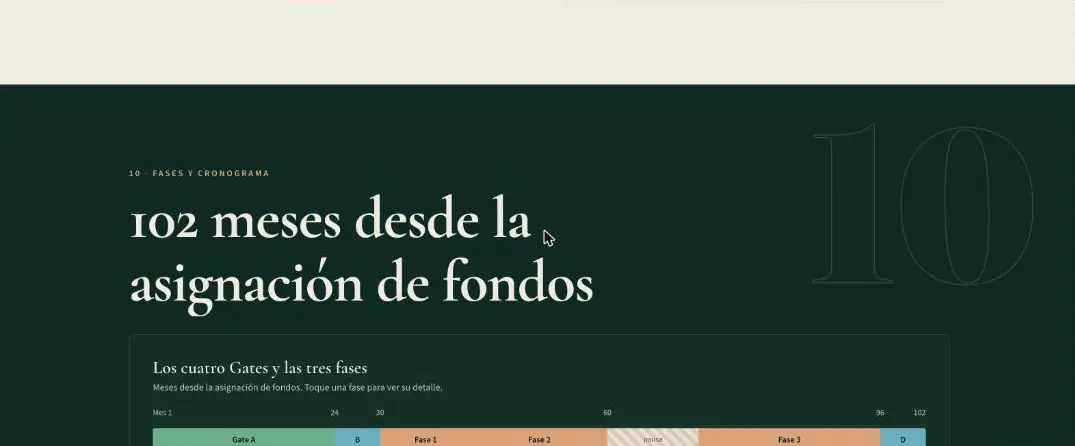
102 months
Counted from the allocation of funds, with a 12-month pause between the second and third phases to verify jobs and income.
pio.emandatum.com
The four Gates and three phases on one timeline.
The impact
Four objectives, each with an indicator
The site ties the project to four of the Sustainable Development Goals, each with a measurable indicator: housing (20,000 seismic-resistant homes), employment (a 5,000-job service center and a plant producing 100,000 tonnes a year), health (a 150-bed hospital and eight neighborhood clinics) and education (15,000 school places and 3,000 technical and university training places).
The conditions
What is assumed is said as assumed
The project is version 0.9, dated November 2026, with no independent verification or approval yet, and it says so. It also lists decisions that belong to the authorities: prior consultation where it applies, the legal form of the local entity, the regime for international cooperation funds, a letter of interest from national and departmental authorities, and environmental licensing and permits.
A note on the images. The photos on the site are concept ideas, not final designs or real works, and the page is informational: the technical documents govern.
This project also has a detailed technical document (investment costs, break-even point, maintenance, financing and ownership) available to members of the Order, who may request it from the Chancellery of the Order in their country.
Elizabeth was born in 1207 in the Kingdom of Hungary, the daughter of King Andrew II. At about 14 she married Louis IV, Landgrave of Thuringia, and moved to the Wartburg castle in Germany.
A life of charity
From an early age she was known for caring for the poor, the hungry and the sick, often at her own expense. When Louis died in 1227 while on his way to the Crusade, Elizabeth left the castle, took up a simple life and joined the Third Order of St. Francis.
The hospital at Marburg
She used her inheritance to build a hospital at Marburg and cared for patients herself. She died there on 17 November 1231, aged 24. Pope Gregory IX canonized her in 1235, only four years later.
Why she is remembered
Elizabeth is associated with charity and the care of the poor. According to a well-known tradition, bread she was carrying for the hungry turned into roses when she was challenged. Historians treat the story as legend, but it captures what her contemporaries saw in her: generosity that ignored rank.
A thought for today
Her feast is a good reminder that humanitarian work does not require a title or a large budget, only the decision to look at the person in front of us and act.
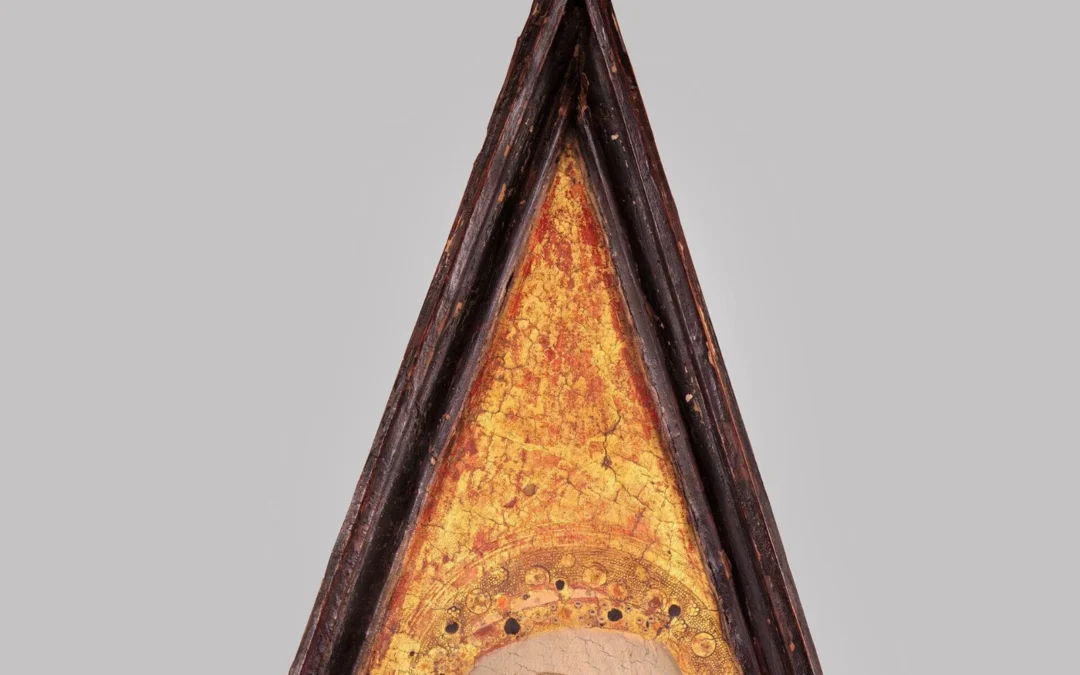
Image: Saint Elizabeth of Hungary, Ambrogio Lorenzetti (CC0), via Wikimedia Commons.
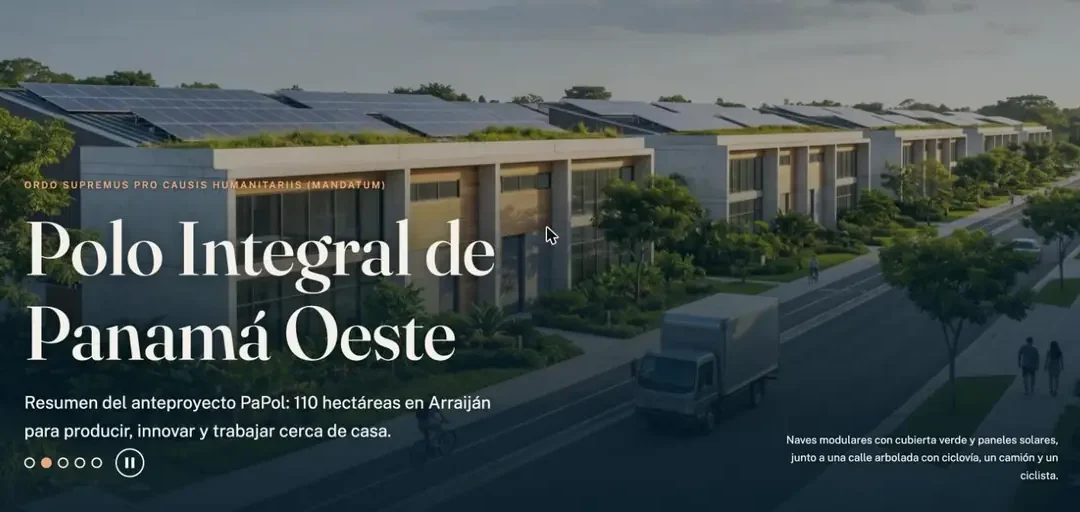
The Polo Integral de Panamá Oeste (PaPol) now has its own website, polo.emandatum.com. It summarizes the Ordo Supremus Pro Causis Humanitariis preliminary project for a 110-hectare productive hub in Arraiján, built to bring jobs closer to home. This is a tour of what it shows.
110 ha
In Arraiján
225,000 m²
Industrial sheds
48 MW
Data centers
126
Months, four Gates
The site is written in Spanish and works as a reading guide to the project: a menu with Need, Territory, Concept, Components, Budget, Schedule and Risks, and a contact button always in view. It earlier appeared in the Herald as a proposal for an integrated hub; now the full preliminary project can be read in one place.
The need
Bringing work to Panama Oeste
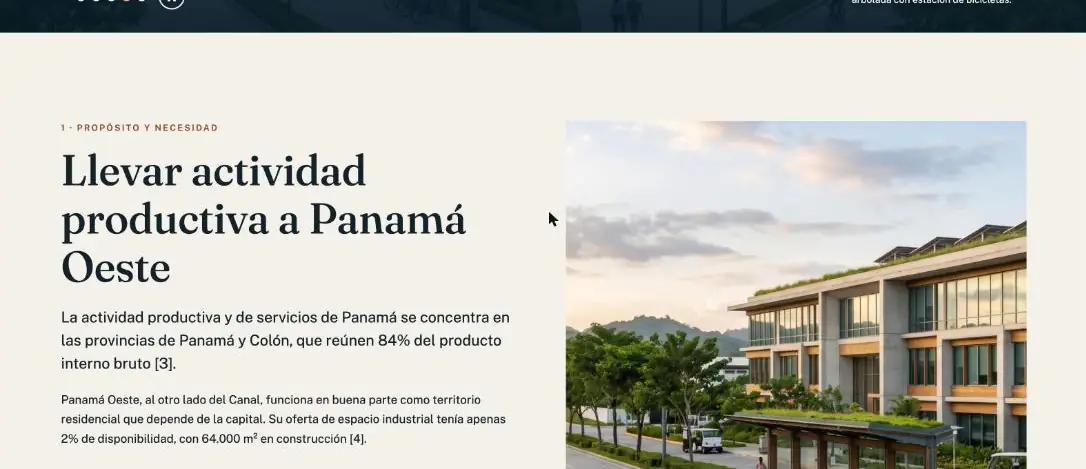
Panama's productive activity is concentrated in the provinces of Panamá and Colón, which together account for 84% of GDP. Panamá Oeste, across the Canal, works largely as a residential area that depends on the capital, and its industrial space had only 2% availability, with 64,000 m² under construction.
The site ties this to the State's own plans: the 2025–2029 strategic plan endorsed by the Cabinet on December 26, 2024, and the National Advanced Technologies Agenda launched on July 30, 2026, which prioritizes semiconductors, printed circuit boards and specialized logistics.
polo.emandatum.com
The first section: why Panamá Oeste needs productive activity. Photos on the site are concept images.
The works
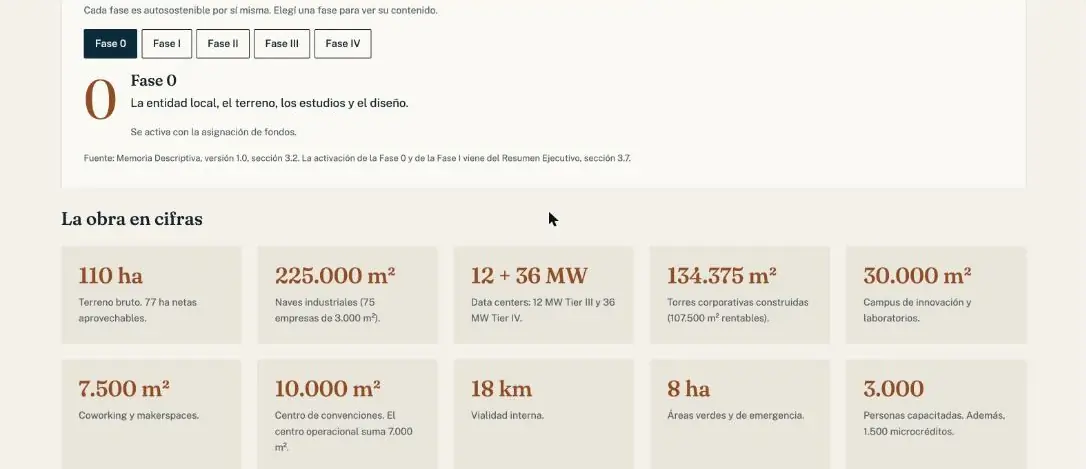
The project in numbers
The Concept section gathers the project's figures. They describe a complete hub rather than a single building: industrial sheds, fiber and data centers, an innovation campus, three corporate towers, coworking, a convention center, an operations center, green and emergency areas, and a training and microcredit program.
polo.emandatum.com
The works in figures, with the phases selector above.
The layout
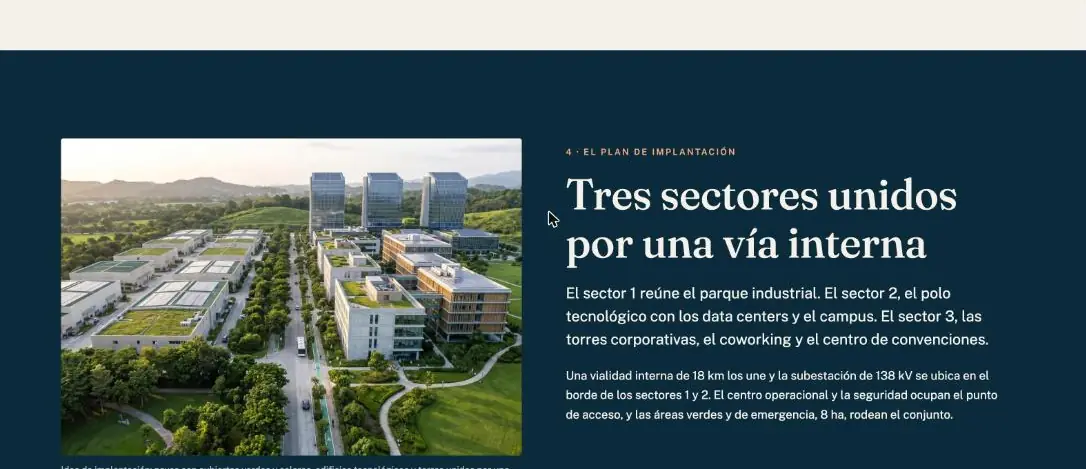
Three sectors, one internal road
Sector 1
Industrial park
Modular sheds for light manufacturing and logistics.
Sector 2
Technology hub
Data centers and the innovation campus, next to the 138 kV substation.
Sector 3
Towers and meeting place
Corporate towers, coworking and the convention center.
An 18 km internal road joins them, the operations center and security sit at the access point, and 8 hectares of green and emergency areas surround the whole. The site presents this as a reference layout that the master plan will fix later.
polo.emandatum.com
The implementation plan: three sectors united by an internal road.
The components
What gets built
Industrial park
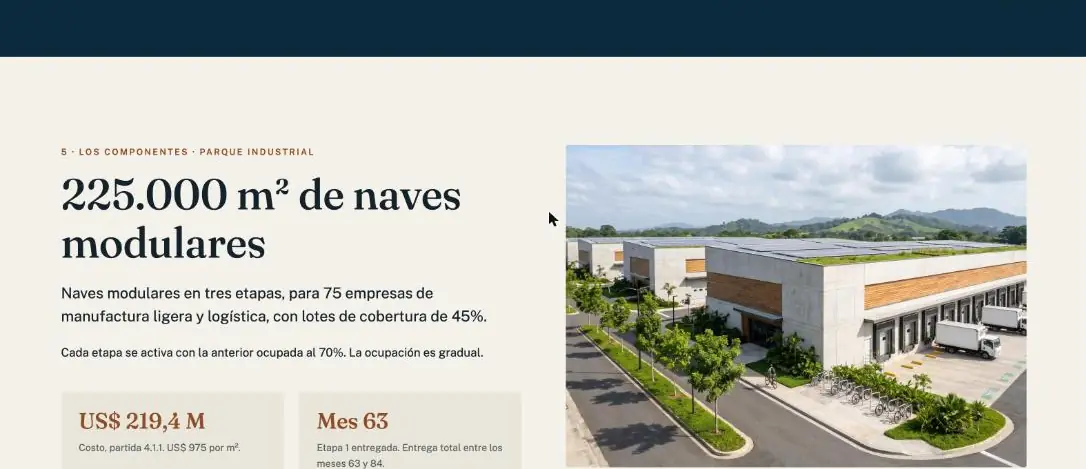
225,000 m² of sheds
Three stages for 75 companies. Each stage opens only when the previous one is 70% occupied.
Technology hub
Fiber, data centers, campus
Backbone fiber with an exchange point, a 12 MW Tier III data center, 36 MW of Tier IV in three stages, and a 30,000 m² innovation campus.
Corporate towers
Three Class A towers
134,375 m² built to LEED Gold standard, opening one after the other as occupancy grows.
Local development
Coworking and training
7,500 m² of coworking, training for 3,000 people and a revolving microcredit fund for 1,500 entrepreneurs.
polo.emandatum.com
The industrial park: modular sheds with green roofs, shown as a concept image.
The principle
Grow only when it is occupied
Each stage opens only when the one before it is occupied.
This is the rule that runs through the whole project. The hub is designed to sustain itself from tenant rents, with no debt and no fiscal cost to the State, and the data center stages open only against signed operator contracts and available power. A sustainment fund of US$ 20.1 million covers early shortfalls and is released only against certified operating deficits.
The money
Every payment goes straight to who did the work
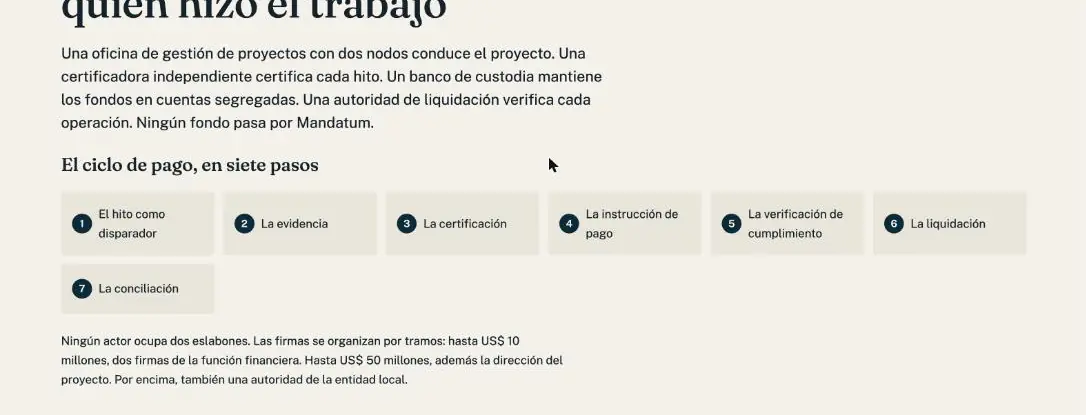
The governance section describes a project management office with two nodes, an independent certifier for each milestone, a custodian bank holding segregated accounts, and a settlement authority that verifies every transaction. No funds pass through Mandatum. Payments follow seven steps, and no actor holds two of them.
1
Milestone as trigger
2
Evidence
3
Certification
4
Payment instruction
5
Compliance check
6
Settlement
7
Reconciliation
polo.emandatum.com
The payment cycle, in seven steps.
The budget
Cost, schedule and the four Gates
Total cost
US$ 2,544.1 million
Includes a contingency reserve of US$ 513.0 million.
Schedule
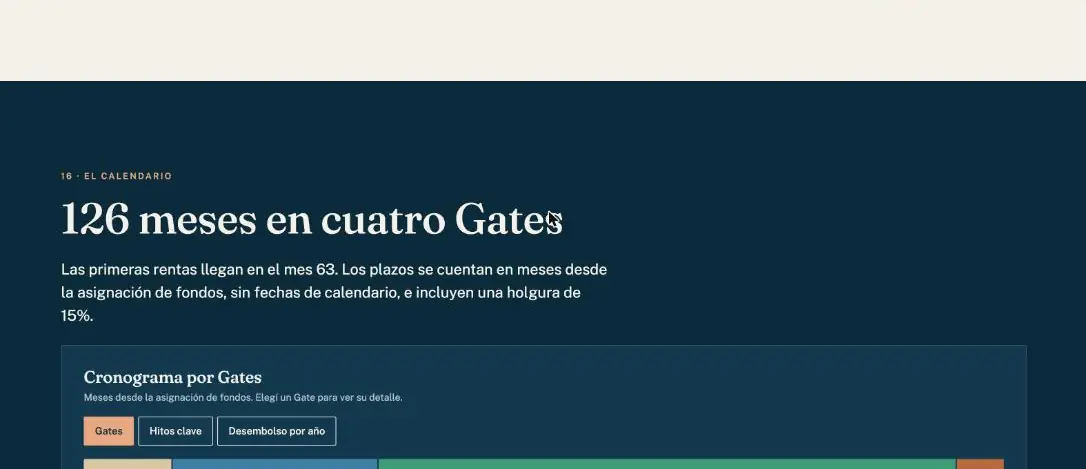
126 months
Counted from the allocation of funds, in four Gates, with a 15% buffer. First rents arrive in month 63.
polo.emandatum.com
The schedule: 126 months in four Gates.
The conditions
What the project asks of government
The final section is frank about what the project needs. It lists four government decisions: officially recognizing the need in Panamá Oeste and naming a technical contact, applying the existing free zone, multinational headquarters and manufacturing regimes to incoming companies, confirming that the chosen lot has industrial and technology use, and the benefactor's contribution by Gate. It also states nine assumptions, from unit costs to power for the data centers.
A note on the images. The photos on the site are concept ideas, not final designs or built works, and the page is informational: the technical documents govern.
This project also has a detailed technical document (investment costs, break-even point, maintenance, financing and ownership) available to members of the Order, who may request it from the Chancellery of the Order in their country.

 Barça
 Peñarol
 Inter Miami