The International Day for Tolerance is held on 16 November. It commemorates the Declaration of Principles on Tolerance, adopted by UNESCO's member states on 16 November 1995. The United Nations General Assembly later invited countries to observe the day.
What tolerance is, and is not
The Declaration describes tolerance as respect for and appreciation of the diversity of the world's cultures and ways of being human. It does not ask anyone to give up their own convictions. It asks us to live peacefully alongside people who hold different ones.
An old idea with a famous defender
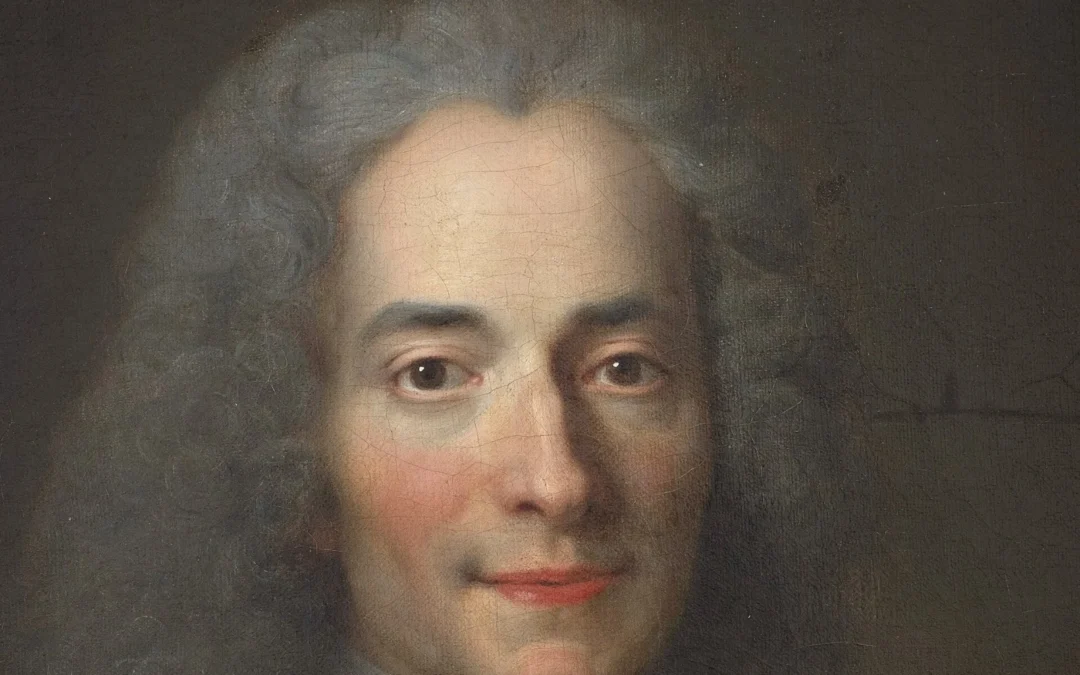
The French writer Voltaire wrote his Treatise on Tolerance in 1763 after the case of Jean Calas, a Protestant merchant executed in Toulouse the year before. Voltaire argued that religious fanaticism, not difference itself, was the danger.
Six everyday ways to practice it
Listen to the end before you answer.
Disagree with the idea, not with the person.
Learn the basics of a faith or culture different from your own.
Correct jokes and rumors that stereotype a group.
Share a meal or a project with people outside your usual circle.
Ask yourself what you would want others to do if you were in the minority.
Image: Portrait of Voltaire by Nicolas de Largillière (CC0), via Wikimedia Commons.
Ordo Supremus Pro Causis Humanitariis has opened its new official website, emandatum.com: the Order's main point of contact with members, benefactors and the public, explained in plain language. Here is a tour of its main parts.
5
Pillars
5
Steps
4
Gates
5
Languages
The front door
Service is our tradition
The home page opens with the Order's motto over an image of the kind of community Mandatum wants to help build: homes, green roofs, a tram line and students on the paths. The menu leads to The Order, Organization, Projects, Education and Press, with a Participate button always in view, language links for English, Spanish, Catalan, French and Dutch, and an accessibility toolbar for text size, contrast and animations.
The tradition
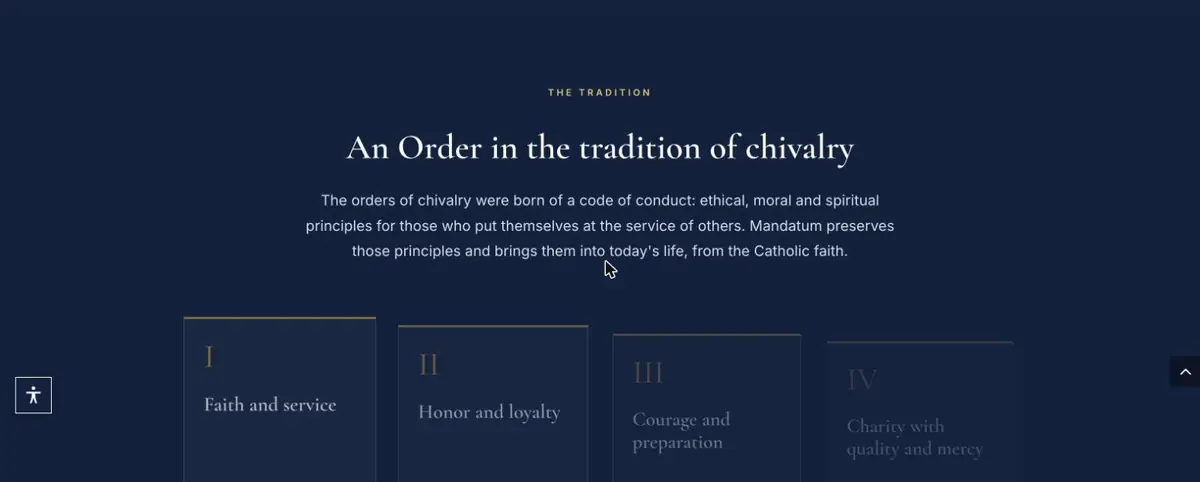
An Order in the tradition of chivalry
The orders of chivalry were born of a code of conduct, and Mandatum keeps those principles and brings them into today's life from the Catholic faith. The site shows four of them, each with a version from yesterday and one for today.
I
Faith and service
II
Honor and loyalty
III
Courage and preparation
IV
Charity with quality and mercy
emandatum.com
The tradition section of the new site.
The members
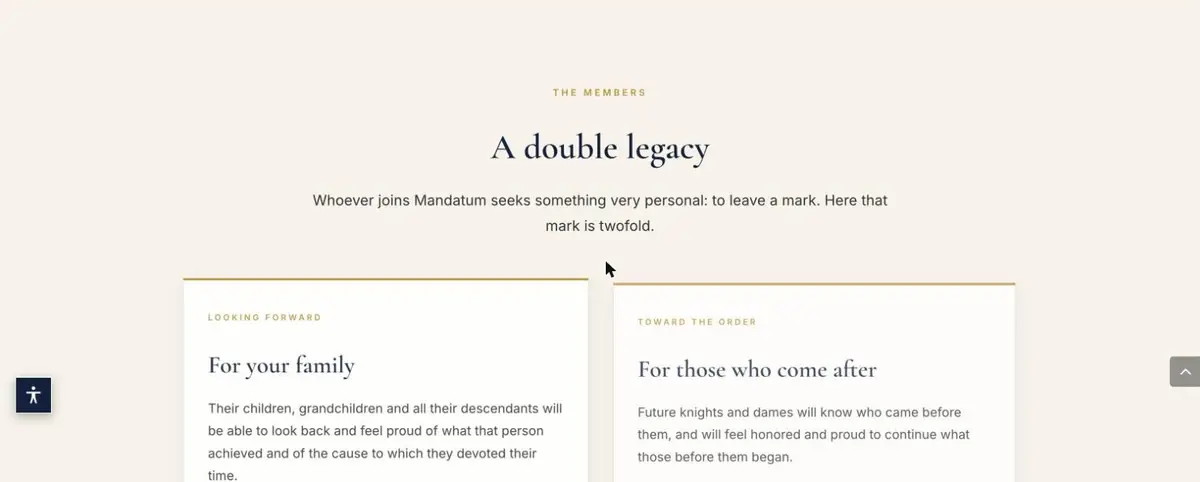
A double legacy
Looking forward
For your family
Children, grandchildren and descendants can look back with pride on the cause a member served.
Toward the Order
For those who come after
Future knights and dames will know who came before them and continue what they began.
Titles are personal, not hereditary, and are awarded for merit.
emandatum.com
Members leave a mark that is twofold.
What we do
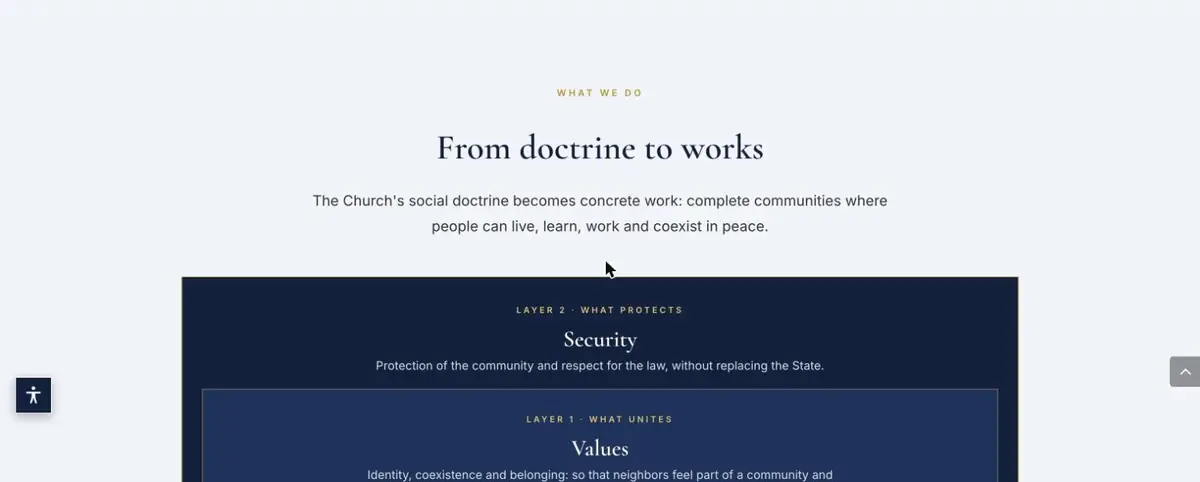
From doctrine to works
The Church's social doctrine becomes concrete work: complete communities where people can live, learn, work and coexist in peace.
Layer 2 · What protects
Security
Protection of the community and respect for the law, without replacing the State.
Layer 1 · What unites
Values
Identity, coexistence and belonging, so neighbors feel part of a community.
HousingEducationWork
emandatum.com
Two layers, Values and Security, rest on three pillars.
The method
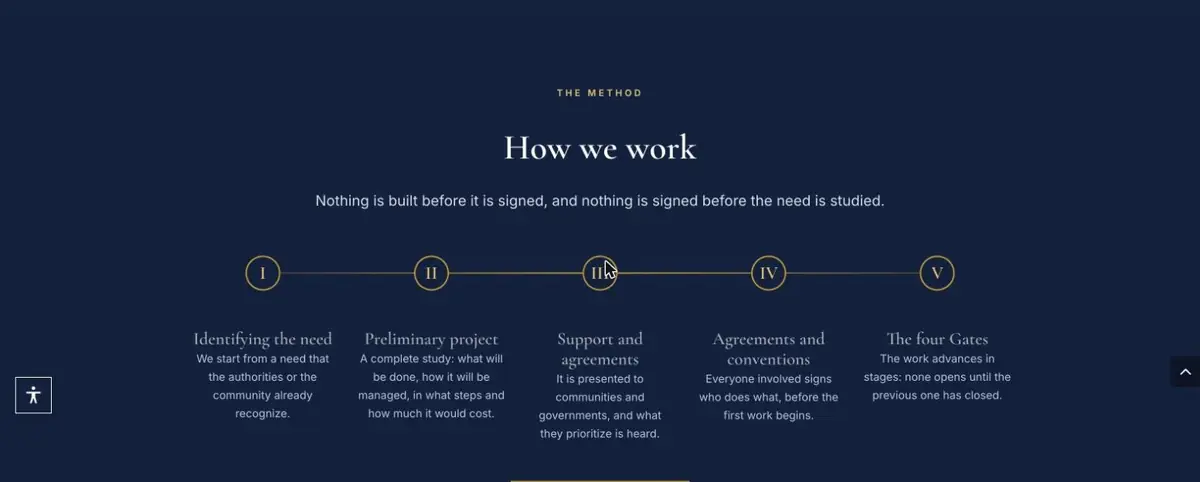
How the Order works
Nothing is built before it is signed, and nothing is signed before the need is studied.
I
Identifying the need
Start from a need the authorities or the community already recognize.
II
Preliminary project
A complete study of what, how, in what steps and at what cost.
III
Support and agreements
Presented to communities and governments.
IV
Agreements and conventions
Everyone involved signs who does what.
V
The four Gates
The work advances in stages; none opens until the previous one closes.
emandatum.com
The method as shown on the site.
Trust
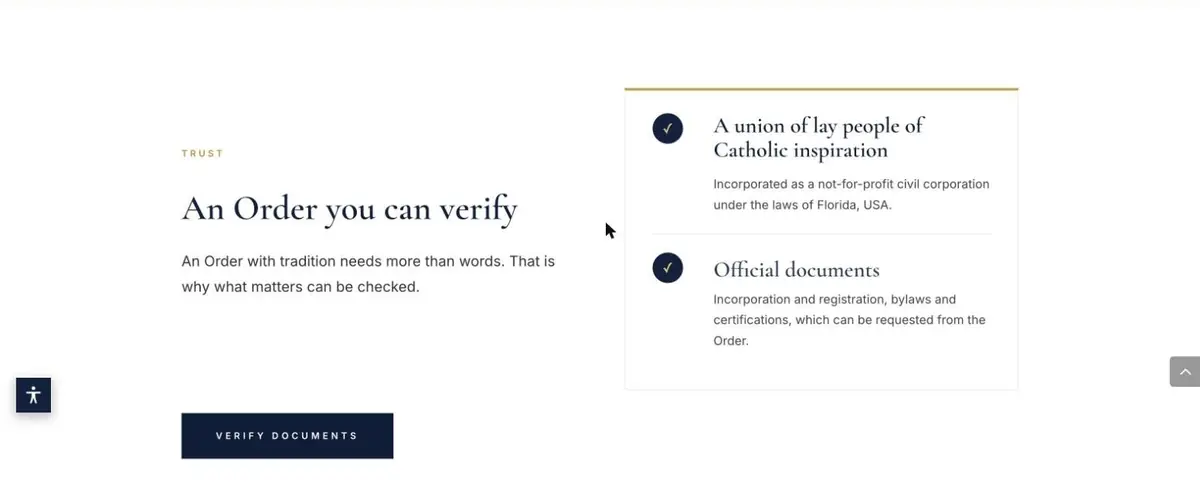
An Order you can verify
Who we are
A union of lay people of Catholic inspiration
Incorporated as a not-for-profit civil corporation under the laws of Florida, USA.
The records
Official documents
Incorporation and registration, bylaws and certifications can be requested from the Order. A Verify documents section is part of the menu.
emandatum.com
The trust section of the new site.
Projects and education
Where the work is going
Preliminary projects
Four projects, four sites
Bocas del Toro, Suriname, Buenaventura and Chocó each have their own website.
Education
ERUDI
The General Magisterium, the Diplomatic Academy and the Management Academy.
Get involved
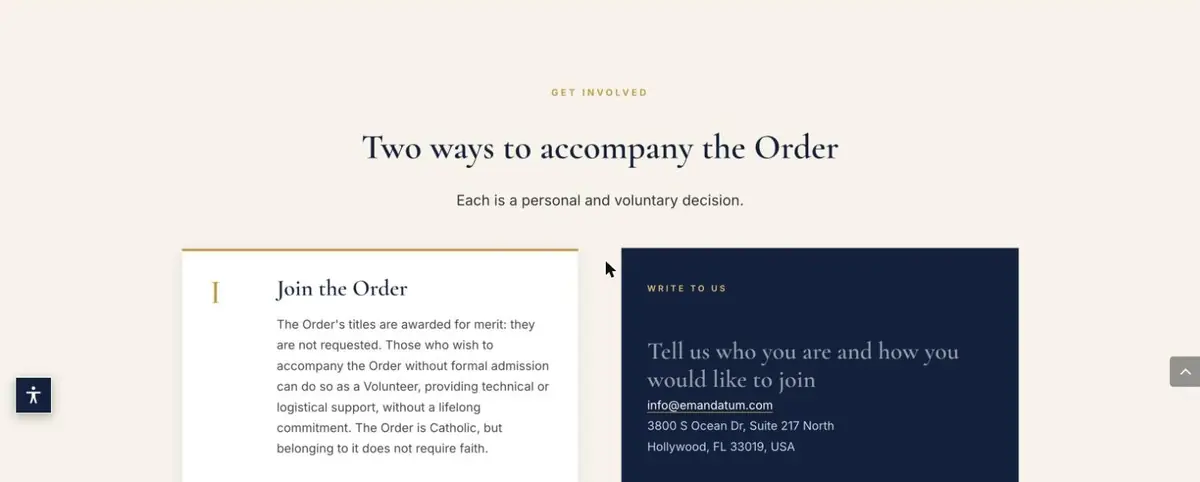
Two ways to accompany the Order
Titles are awarded for merit rather than requested. Those who wish to help without formal admission can do so as volunteers, and the Order is Catholic, but belonging to it does not require faith.
emandatum.com
Join the Order, or write to it.
Discover the Order
The Mandatum Herald is part of the site too: readers can subscribe, pick their sections and choose every story or a monthly summary.
Before the Order commits resources to a community, someone has to write the preliminary project that lets the Council decide. AGEN 201 teaches members of the Order to do exactly that, step by step, by drafting a complete proposal of their own.
The Mandatum Method for Drafting Preliminary Project Proposals is the second course of the Academy of Humanitarian Project Management on ERUDI, the Order's academic platform. It is a hands-on course: across six books and six workbooks, each student learns the Mandatum Method and applies it, one stage at a time, until a full anteproyecto is finished. It is offered in English (AGEN 201) and in Spanish (AGSP 201).
Learning by doing: the Nueva Aurora case
Instead of studying theory in the abstract, students work on a single case from start to finish: the Comunidad Mandatum Nueva Aurora. It is a fictional example, not a real project, built so that every decision a real team faces appears in it. The student plays the role of a preliminary-project analyst in the Office of Preliminary Projects and, workbook after workbook, takes Nueva Aurora from a first idea sheet to a document ready to present to the Council.
Each book is followed by a workbook that turns the lesson into part of the student's own proposal.
Six books, six stages
Each book teaches one of the six stages of the Mandatum Method, and its workbook applies it to Nueva Aurora. Each stage produces concrete results that feed the next, and together they become the twelve sections of the official structure of a Mandatum anteproyecto.
Book I · Understanding the Mandate
What an anteproyecto is and is not, the principles of the Order, the 3 Pillars and 2 Layers model, the team and the ethics of the analyst. Workbook I · Idea Sheet and Project Framing
Book II · Listening to the Community
Diagnosis, baseline, stakeholder map and problem tree, built with the community rather than about it. Workbook II · Participatory Assessment
Book III · Designing the Community
Objectives, logical framework, the components of each pillar and layer, and the physical design. Workbook III · Objectives, Logical Framework, and Components
Book IV · Costing and Sustaining
Investment budget, sources of funds and the plan that sustains the community for about ten years, until it can finance itself. Workbook IV · Budget and Sustainability Plan
Book V · Governing and Protecting
Governance, alliances and agreements, schedule and the risk matrix. Workbook V · Governance, Alliances, Schedule, and Risks
Book VI · Writing and Presenting
The final document, the executive summary (written last) and the presentation to the Council of the Order. Workbook VI · The Complete Preliminary Project Proposal
What every student practises
The alignment test
Five questions that check whether a proposal forms a community, requires shared responsibility, puts education at the centre, has a ten-year plan and respects the right relationship with the State.
The 3 Pillars and 2 Layers
Housing, Education and Work, surrounded by Values and by Security and the Rule of Law, used as a checklist and never as a recipe.
Numbers with sources
Every figure traced to its origin and every cost backed by a calculation, because one unsupported number undermines the whole document.
Speaking of a study, not a promise
How to work in the community without raising expectations before a project is approved and funded.
Who it is for. Members of the Order who will prepare or review preliminary projects: analysts, field coordinators, technical advisers and the officers of the procuratorates who sign off on their area. Before starting, students must have completed the General Magisterium and AGEN 101, the first course of the Academy of Management.
How it works. Books and workbooks are studied in sequence, each with its own exam; the next one unlocks with at least 7 out of 10. Workbook answers are saved in the browser, and students download them at the end of each session to assemble the final proposal. Passing all twelve exams unlocks the course's Academic Certification.
World Kindness Day is observed every year on 13 November. It grew out of the World Kindness Movement, a network of kindness organizations that came together at a conference in Tokyo in 1997, and the day was first marked in 1998.
Why a day for something so simple?
Kindness is easy to praise and easy to postpone. A dedicated day gives families, schools, parishes and workplaces a reason to turn good intentions into a concrete act: a phone call, a meal, an hour of help.
Five small acts for this week
Call or write to someone who may be alone.
Thank a person whose work usually goes unnoticed.
Give an hour to a local food bank, shelter or parish group.
Let someone else go first: in traffic, in a queue, in a conversation.
Say something encouraging before you say something critical.
Kindness as a method
For a humanitarian order such as Mandatum, kindness is not a slogan but a way of working: attention to the person in front of you, followed by action. The photo above shows volunteers packing food boxes, an ordinary task that reaches families they will never meet.
Image: U.S. Navy photo of sailors packing food boxes for the San Diego Food Bank (public domain), via Wikimedia Commons.
There are emotions that time cannot wear away. The one from April 1987 I carry seared into my heart, and even today, when I remember it, my eyes fill with tears. I was 21 when Saint John Paul II walked through an Argentina that was only just waking up to democracy. I remember the cold of that morning on the 9 de Julio, the gentle shoving, the smell of choripán mingling with the incense. Above all I remember what I felt in my chest: half the enthusiasm of youth, half wonder, and the certainty that the whole world was watching us.
That journey (April 6 to 12) gave us back our joy after the dark days of the war. It seems distant to me and, at the same time, so close I could touch it. And further back still, in that tragic, brief June of 1982, there were the barely 31 hours of Karol Wojtyła’s first visit, in the midst of the pain of the Malvinas. From those days I keep, like a wound that is also a treasure, the stifled weeping of my parents at home.
Almost four decades later, life granted me what I never imagined: to live it from the inside, with an open heart, and to feel again what I already knew. This is how the presence of a Pope on Argentine soil transforms a people.
8
Sunday, November 8:An Embrace with a Taste of Nostalgia
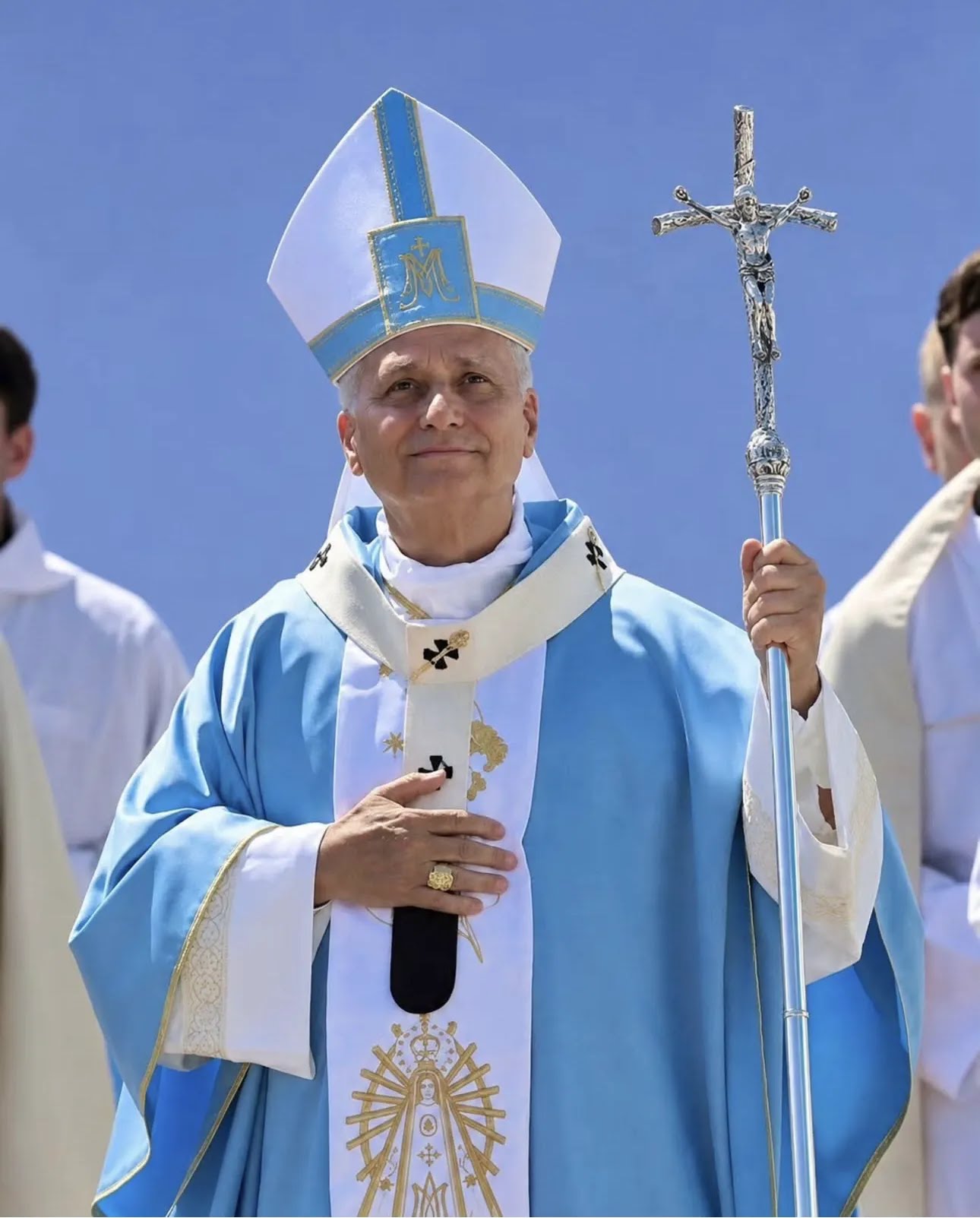
At 4:30 p.m., on the tarmac at Aeroparque, it all began. When Leo XIV came down the steps of the papal plane, the murmur of the sea of people shook me exactly as it did when I was 20. In that instant I stopped being the woman I am and became the girl I once was. I felt that time had never passed.
In the afternoon, at the Palacio Libertad, I could not hold back my emotion when the Pontiff dedicated his first words to Jorge Mario Bergoglio. His voice sounded warm and respectful, and it touched my soul. It was a gesture of love toward the one who had loved us so much:
“I come to this land with a heart full of respect, to gather the footprints and the living memory of Pope Francis, who for twelve years guided the universal Church with the heart of a shepherd close to the marginalized.”
That first day did not leave me with nostalgia alone. I understood, with a mixture of hope and responsibility, that Leo XIV had not come to pass through: he had come to tell us something that would stay with us, deep inside.
“Authority is service. Without disregarding the value of private initiative, society cannot forget those who cannot fend for themselves; it is the responsibility of institutions to extend a hand.”
9
Monday, November 9:A Sea of People in Palermo (2,500,000 souls)
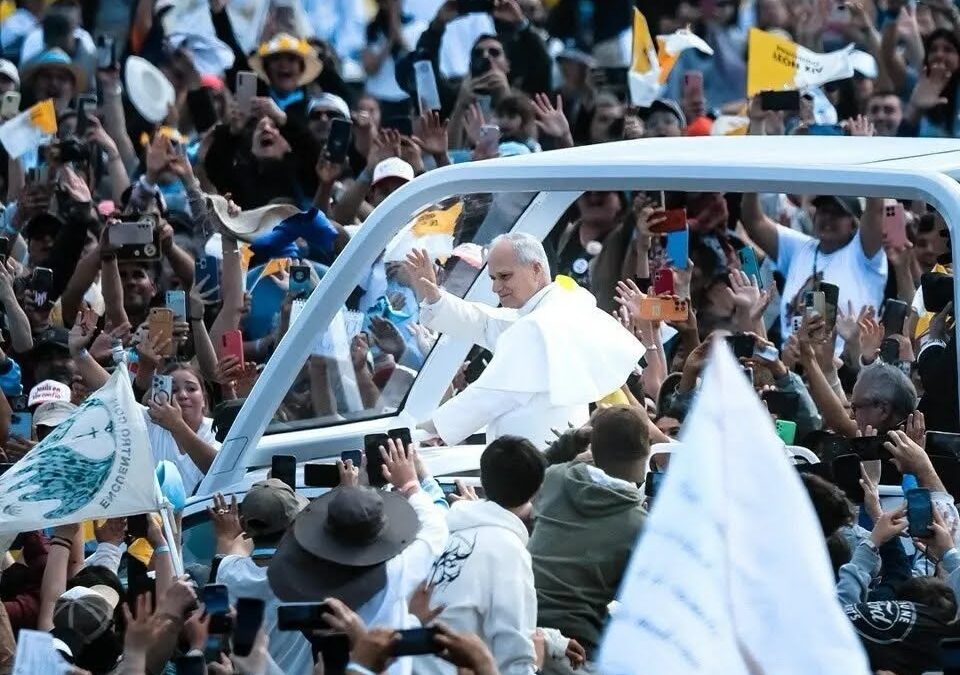
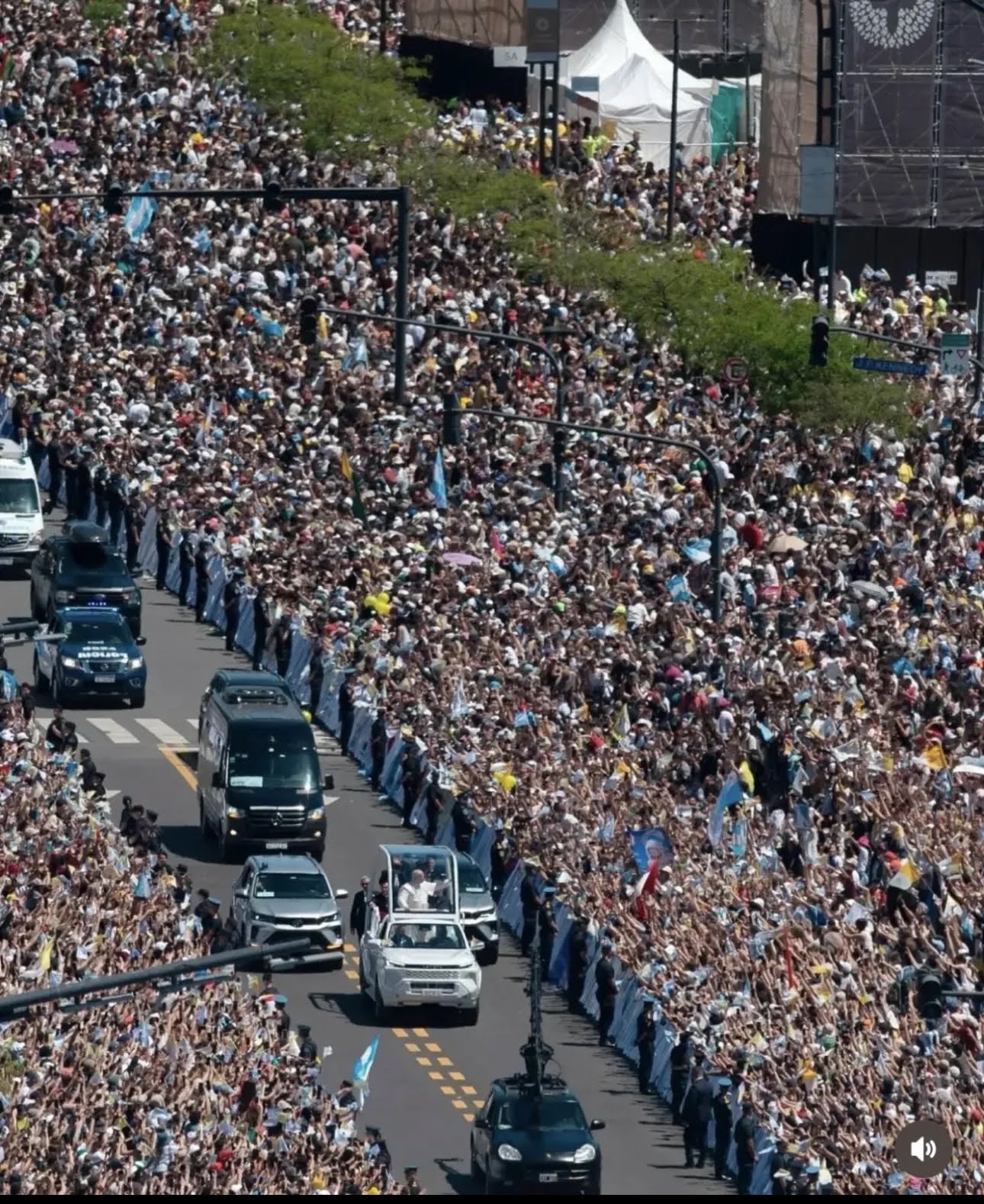
In 1987 I believed I had seen the greatest crowd of my life. That Monday, November 9, taught me, with humility, that I was mistaken. Near the Monument of the Spaniards, the landscape took my breath away: 2,500,000 people filled the woods of Palermo and Avenida del Libertador. I was a drop in that ocean, and I felt immensely happy to be one.
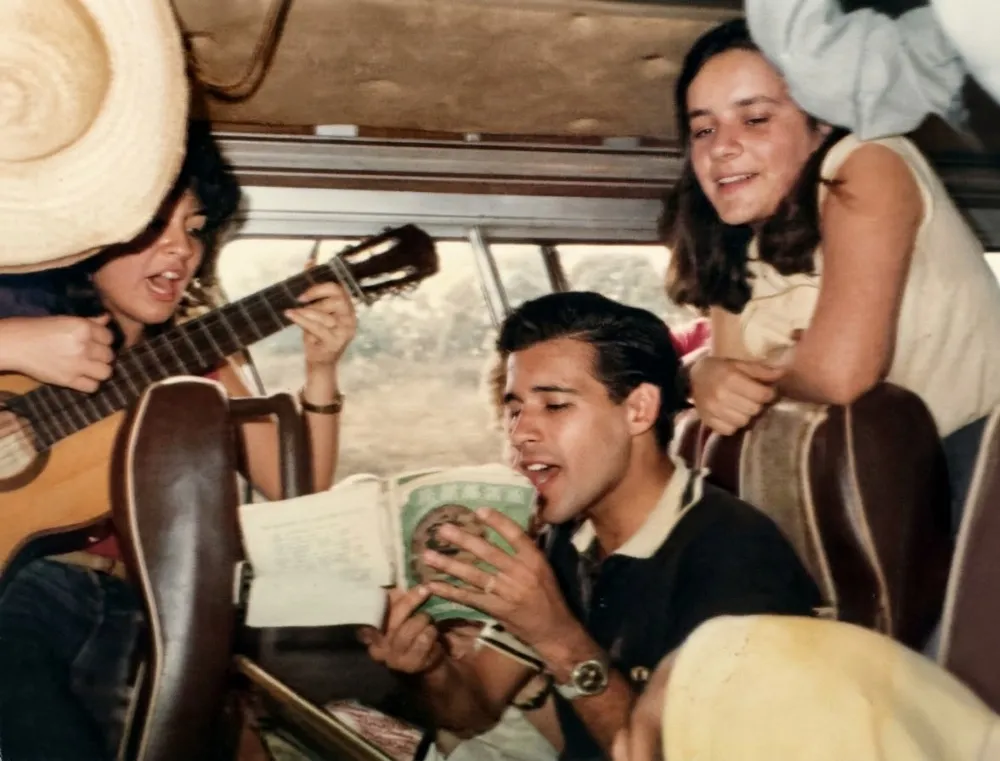
It was there, amid the sea of flags, that the verses of “Alma Misionera” began to resound in every corner and became the anthem of every gathering on this tour. Hearing hundreds of thousands sing it in unison completely disarmed me. I felt my chest open, and all at once I was the catechist of other times again, backpack on my shoulder through the villages of Argentina’s Northeast, when the desire to serve and the giving of ourselves to others marked our every step. I wept for the girl I was, and also for everything I still want to be.
On the right, M.M. Bibiana Casartelli, at 19; in the center, the then-seminarian Jorge Belvedere.
In his homily, Leo XIV spoke straight to the heart of everyday life, and I felt he was speaking of my home, my table, my people:
“Do not resign yourselves to the voices that repeat that the Christian family is outdated; on the contrary, today more than ever it represents a pillar amid the many precarities of our time.”
“In God’s house there is room for everyone. May God bless Argentina so that our homes may always be a temple of his presence and of a shared table.”
And at the vigil, when he broke protocol to approach the young people, I felt my soul catch fire. He uttered a phrase that drew a thunderous ovation, and I applauded with all my heart:
“So much enthusiasm, so much joy! It is because we all know Christ. A round of applause for Jesus!”
10
Tuesday, November 10:Córdoba and the Footprints of the Past (650,000 faithful)
We continued toward the interior, bound for Córdoba, our hearts still beating hard from all we had lived. On the grounds of the Argentine Aircraft Factory (FAdeA), 650,000 people braved the logistics and the heat to gather for an unforgettable open-air Mass. Being there, amid so much faith, felt like being held up by everyone.
The moment that moved me most came when the Holy Father passed in front of the Jesuit Major Residence, where Bergoglio lived in the early nineties. I felt a lump in my throat: Francis’s footprints were still there, waiting for us. From the balcony of the Archbishopric, on Avenida Hipólito Yrigoyen, the Pope reflected:
“My encounter with Francis transformed me deeply. I hope that those who share in this celebration today may carry away a message of hope, to become better people and to commit themselves more to others.”
I carried those words away like a charge entrusted to me. I felt called to be better, and to commit myself more to others.
11
Wednesday, November 11:Devoto, the Silence of Luján and an Unforgettable Farewell (3,500,000 pilgrims)
The last day began early at Devoto Prison, far from the glare of the great stages. It was a profound, human experience, and it stirred me deep inside. Leo XIV stopped before the inmates with a transparent empathy, and I felt that this silence was worth more than any crowd:
“Visiting prisoners is a work of charity and mercy to which we are all called... When Jesus spoke of charity, he did so with a prisoner, and when he lost his life, one of them accompanied him. Let us ask Jesus the captive to grant them strength.”
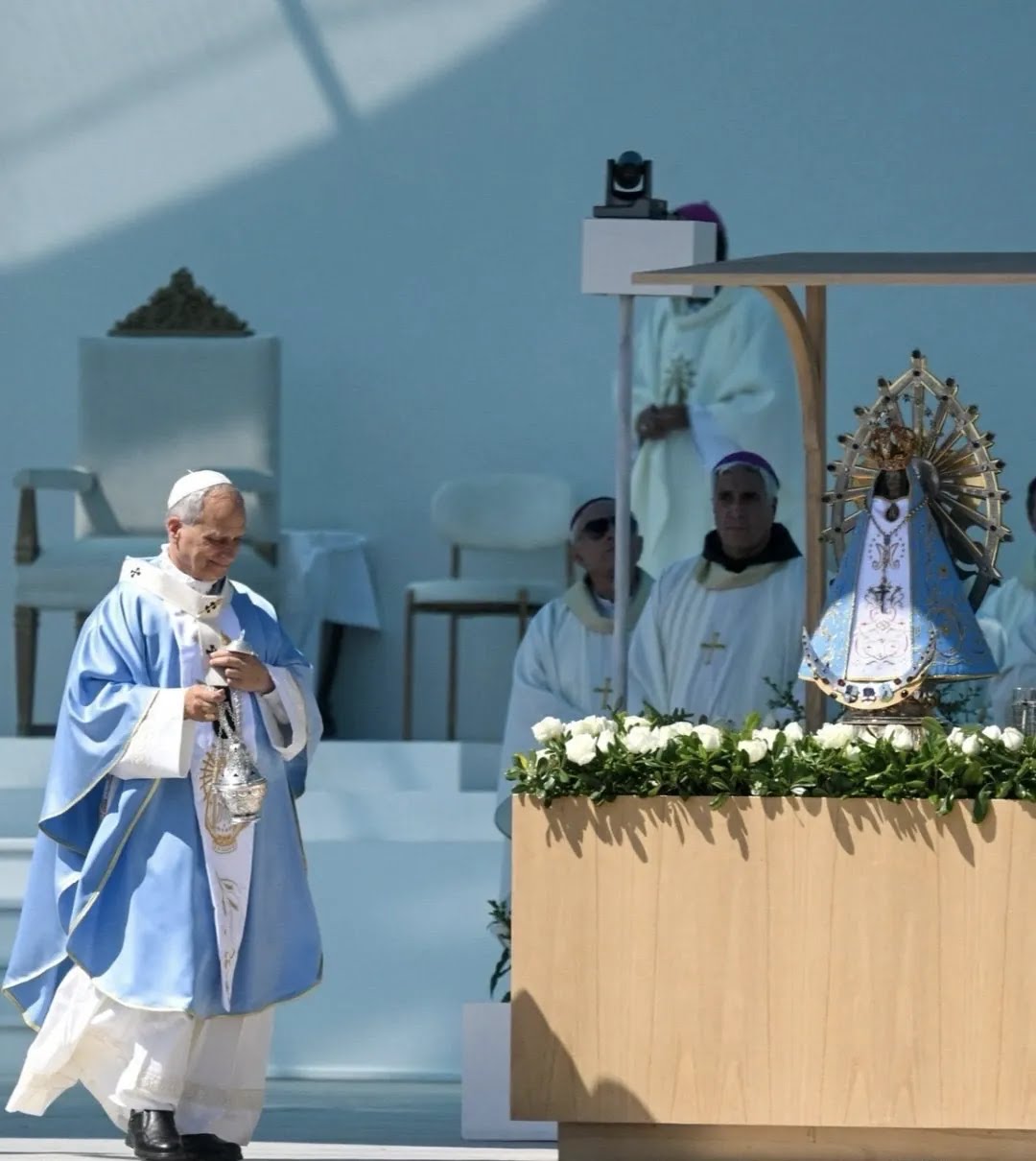
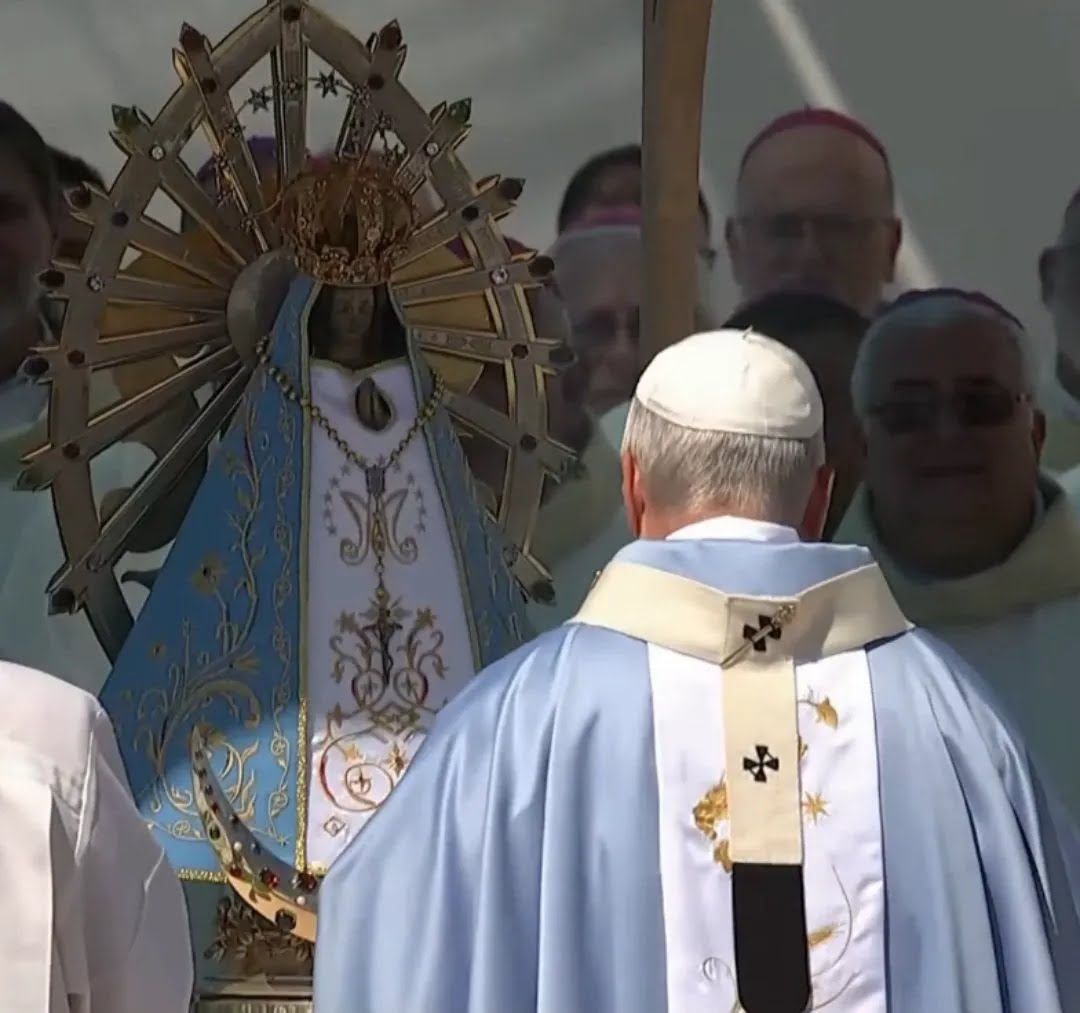
Around midday, it all culminated at the Basilica of Our Lady of Luján1. There I witnessed the most awe-inspiring human gathering in the history of our country: 3,500,000 pilgrims overflowed Plaza Belgrano, the access roads and the neighboring fields. I felt part of something greater than myself, greater than all of us.
Listening to the homily in Luján, I stopped being a chronicler. I was, quite simply, one more Argentine woman listening to her Shepherd, with my heart in my hand:
“I thank God for the opportunity to meet this beloved people, who open their doors to all, who share their bread and their music, where there is always a place at the table for the one who arrives, a free moment to talk over mate after mate, a hand stretched out to whoever needs it.”
“Argentina, rise up and walk! Do not be afraid; the Lord inspires in our faithful People heroic gestures of charity... Go out and build bridges and networks of solidarity.”
I felt he was speaking to me, to each one of us, and that I could not stay still. And before leaving for Ezeiza, he gave us a phrase that stayed engraved in me forever, and that is today the collective memory of an entire people:
“Thank you for receiving me with so much affection. I have felt at home. You may say that from now on this country has two popes: one who was born here and another by adoption. Hasta siempre, my dear Argentina!”
Itinerary Summary and Official Attendance
Event / Venue
Location
Attendance
Central Mass of Buenos Aires
Palermo / Monument of the Spaniards
2,500,000 people
Pastoral Mass of Córdoba
FAdeA Esplanade (Córdoba)
650,000 people
Closing Mass in Luján
Basilica and Plaza Belgrano (Luján)
3,500,000 people
Total across public Masses
—
6,650,000 people
In all, Leo XIV reached more than 8 million people along the way and in other places such as squares and the Nunciature.
Looking back over these four days, I understood that the years have passed and that the fervor of youth has given way to a faith that is more mature, more serene, more my own. But it was enough to hear those mission songs resounding in the crowd again to discover that nothing had gone out. The vocation of service and the hope of a people gathered remain intact, exactly as I felt them in 1987. And I hold on to a promise: not to watch from the outside, but to rise up, walk and extend a hand.
1Luján, in the province of Buenos Aires, is home to the country’s principal Marian shrine. Its devotion began in 1630, when, according to tradition, the cart carrying a small image of the Immaculate Conception stopped on the banks of the Luján River and could not go on. In 1930, Pope Pius XI proclaimed Our Lady of Luján patroness of Argentina, Uruguay and Paraguay. The present basilica, in the neo-Gothic style, began to be built in 1890.↩

 Barça
 Peñarol
 Inter Miami