The boundary between human intuition and machine efficiency is creating a synergy for creators worldwide. For years the narrative around Artificial Intelligence was fear of replacement; the reality is proving to be a powerful partnership.
The digital co-pilot: beyond automation
AI is not a substitute for the soul of the artist or the vision of the entrepreneur; it serves as a digital co-pilot. It is designed to handle the repetitive, mundane tasks that drain our mental energy daily. By delegating the “boring” work to algorithms, we reclaim the time needed for deep, meaningful innovation.
The true power of the partnership lies in liberating the human intellect from the mechanical constraints of data processing and formatting. AI acts as a sophisticated filter, surfacing the patterns and insights that would take a human brain weeks to identify. The spark of an idea can be fanned into a flame almost instantly: we are not just working faster, we are thinking deeper and reaching for more ambitious goals.
The end of blank page syndrome
One of the most significant hurdles for any writer, designer or engineer is the paralyzing fear of starting from zero. Generative AI acts as a “brainstorming partner” that provides immediate, diverse perspectives on any topic. With a base layer of ideas or technical drafts, creators can jump straight into refinement and emotional polishing, and complex projects move from concept to reality in record time.
The creative journey turns from a lonely struggle into a dynamic dialogue. Instead of waiting for a random moment of inspiration, professionals can provoke it by exploring a multitude of variations. This does not diminish the creator; it elevates them to master curator and editor, who defines the final vision. The cost of experimentation has dropped to nearly zero, and we see a surge in “hybrid” works that blend styles and disciplines in ways once impossible.
Personalized learning: democratizing mastery
Integrating AI into education is perhaps the most noble application of the technology. Every person processes information differently, and AI can adapt a curriculum to each student’s pace and style. Someone interested in quantum finance or cybersecurity can have a “private tutor” available twenty-four hours a day.
Closing gaps
AI-driven systems can identify gaps in a student’s understanding that a traditional classroom might overlook.
Instant feedback
Alternative explanations ensure that no student is left behind by a rigid or outdated teaching method.
Lifelong learning
A more inclusive environment where learning is practical for people of all ages and backgrounds.
Social mobility
Specialized skills become accessible to those previously excluded by cost or location.
The human touch: the premium of authenticity
As the world fills with digitally generated content, the value of the human touch and authentic storytelling reaches a historic premium. AI can generate data-driven reports or functional code, but it cannot replicate the lived experience and emotional depth of a human being. The future belongs to those who master the technical tools while keeping a strong, identifiable human voice.
Technology becomes the brush, but the human spirit remains the only true painter of our reality. A machine can mimic a style, but it cannot understand the “why” behind a piece of art or a groundbreaking strategy. Human value lives in the ability to bridge the cold logic of data with the warmth of empathy; audiences crave connection and meaning over mere perfection.
Ethical innovation: building a trustworthy future
The transition into an AI-driven society requires a conscious commitment to ethics and transparency, so that these tools benefit all of humanity equally. Leading developers and global organizations are focusing on “explainable AI,” which lets users understand the logic behind each automated decision, a transparency crucial to public trust in sensitive areas like medicine or urban planning. By prioritizing human values in the code itself, technology remains a servant to our collective progress. Innovation without ethics is a hollow pursuit; innovation with purpose is the key to a flourishing future.
Ultimately, the responsibility for how we use these instruments lies with us as a global community. We must take part in the conversation about bias, privacy and the long-term effects of automation in the workplace. By fostering a culture of “human-centric AI,” we can mitigate the risks while maximizing the benefits. This is not just a technological shift; it is a moral one that invites us to define what kind of future we want to build. When we align our technical prowess with our highest virtues, we create a world where everyone has the power to thrive.
In a society obsessed with immediate recognition and the hollow validation of social media, the act of giving has frequently devolved into a spectacle. For the Order, assisting our neighbor is a sacred duty exercised with profound discretion.
Many today strive to ensure that their left hand knows exactly what their right hand is doing, prioritizing a curated photo opportunity over the actual solution to the problem at hand. For the Order of Mandatum, assisting our neighbor is not a marketing strategy or a tool for personal branding. We believe that the value of a noble action resides in its purity of intent rather than the volume of applause it garners.
Silent philanthropy
This approach, known as “silent philanthropy,” allows our work to take deep root and create a lasting impact. By removing the individual ego from the equation, we shift the focus from the “benefactor” to the “community.” When we stop seeking to stand out as individuals, we begin to stand together as a cohesive force for good, preserving the dignity of those we serve.
Helping without intrusion: respect as our premise
True generosity is not an act of superiority or a display of individual wealth; it is an exercise in fraternity where the giver and the receiver meet as equals. Charity proclaimed loudly can inadvertently wound the dignity of those facing hardship and turn a human connection into a transaction of power.
Reserve
Missions are conducted with the utmost reserve, without turning support into a media event.
Transformation
The reward is witnessing the positive transformation of a community, not seeing one’s own name on a plaque.
Trust
Respect for privacy builds an unbreakable bond of trust between the Order and the society it serves.
It is a form of collective leadership that requires no pedestals; its authority emanates from consistency, humility and a genuine commitment to the common good.
The impact of the invisible
The smallest and most discreet actions are often those that weave the strongest threads into the social fabric. Silent philanthropy lets us use resources with technical efficiency, ensuring that every contribution goes toward the cause rather than being wasted on image campaigns or unnecessary bureaucracy.
From supporting the education of talented youth to bolstering critical infrastructure in vulnerable areas, our works speak for themselves. We do not seek to change governments or nations through public criticism; we transform them by building tangible, positive solutions from the ground up.
A member of the Order knows that their true legacy is not written in headlines, but in the hearts of a community empowered to stand on its own. We do not act so that we may be seen; we act so that the community may thrive.
Seventeen goals, 169 targets and one deadline. This guide explains what the Sustainable Development Goals are, what each one seeks, and how far the world still has to go.
In September 2015, the 193 member states of the United Nations adopted the 2030 Agenda for Sustainable Development, a shared plan to end poverty, protect the planet and ensure that all people can live in peace and prosperity. At its heart are the Sustainable Development Goals, known as the SDGs: seventeen goals that, for the first time, apply to every country in the world, rich and developing alike.
Ten years on, with less than five years remaining, they are still the most complete roadmap humanity has agreed upon.
What the SDGs are
The SDGs replaced the Millennium Development Goals, which guided international efforts between 2000 and 2015 and focused mainly on developing countries. The new agenda is broader and universal. It holds that ending poverty must go hand in hand with strategies that build economic growth and address education, health, social protection and jobs, while tackling climate change and protecting the environment.
The central promise: leave no one behind. Each goal is broken down into specific targets, and each target is followed through measurable indicators. The goals say what must be achieved; the targets say how and how much.
Five dimensions, seventeen goals
The agenda is organized around five dimensions, known as the five Ps: people, planet, prosperity, peace and partnership. The chart shows how the seventeen goals are distributed among them.
Goals by dimension
People
5
Planet
5
Prosperity
5
Peace
1
Partnership
1
Source: United Nations, 2030 Agenda. Graphic: Mandatum Herald.
The seventeen goals, group by group
Open each group to see what its goals seek and the key target behind each of them.
People · 5 goals
Ending poverty and hunger, and ensuring dignity, health, education and equality for every human being.
1
No Poverty
End poverty in all its forms everywhere.
Key target: Social protection floors for all, and equal rights to economic resources.
2
Zero Hunger
End hunger, achieve food security and improved nutrition, and promote sustainable agriculture.
Key target: Sufficient, nutritious food all year round, and doubled productivity of small-scale producers.
3
Good Health and Well-being
Ensure healthy lives and promote well-being at all ages.
Key target: Fewer than 70 maternal deaths per 100,000 live births; an end to preventable deaths of newborns and children under five; universal health coverage.
4
Quality Education
Ensure inclusive and equitable quality education and lifelong learning opportunities.
Key target: Free, equitable and quality primary and secondary education for every girl and boy.
5
Gender Equality
Achieve gender equality and empower all women and girls.
Key target: An end to discrimination and violence, and full participation in political, economic and public life.
Planet · 5 goals
Protecting the planet from degradation: water, sustainable consumption, climate, oceans and land.
6
Clean Water and Sanitation
Ensure availability and sustainable management of water and sanitation for all.
Key target: Universal access to safe drinking water, sanitation and hygiene.
12
Responsible Consumption and Production
Ensure sustainable consumption and production patterns.
Key target: Halve per capita food waste and substantially reduce waste generation.
13
Climate Action
Take urgent action to combat climate change and its impacts.
Key target: Strengthen resilience and adaptive capacity, and integrate climate measures into national policies.
14
Life Below Water
Conserve and sustainably use the oceans, seas and marine resources.
Key target: Reduce marine pollution and protect coastal and marine ecosystems.
15
Life on Land
Protect, restore and promote sustainable use of terrestrial ecosystems, forests and biodiversity.
Key target: Halt deforestation, restore degraded land and stop the loss of biodiversity.
Prosperity · 5 goals
Ensuring that all people can enjoy prosperous and fulfilling lives in harmony with nature.
7
Affordable and Clean Energy
Ensure access to affordable, reliable, sustainable and modern energy.
Key target: Universal access to modern energy and a substantially larger share of renewables.
8
Decent Work and Economic Growth
Promote sustained, inclusive growth, full employment and decent work for all.
Key target: Full and productive employment, an end to forced and child labour.
9
Industry, Innovation and Infrastructure
Build resilient infrastructure, promote inclusive industrialization and foster innovation.
Key target: Reliable, sustainable infrastructure and universal access to information technology.
10
Reduced Inequalities
Reduce inequality within and among countries.
Key target: Income growth of the poorest 40 per cent above the national average, and the social, economic and political inclusion of all.
11
Sustainable Cities and Communities
Make cities and human settlements inclusive, safe, resilient and sustainable.
Key target: Access to adequate, safe and affordable housing and basic services for all.
Peace · 1 goal
Fostering peaceful, just and inclusive societies, free from fear and violence.
16
Peace, Justice and Strong Institutions
Promote peaceful and inclusive societies, access to justice for all and accountable institutions.
Key target: Significantly reduce violence, and ensure legal identity and public access to information.
Partnership · 1 goal
Mobilizing the means to implement the agenda through a revitalized global solidarity.
17
Partnerships for the Goals
Strengthen the means of implementation and revitalize the global partnership.
The goals cannot be achieved in isolation. Decent housing improves health; education opens the way to decent work; clean energy reduces pollution and protects the climate; peace and strong institutions make every other investment possible. Progress in one goal strengthens the others, and setbacks in one weaken the rest.
This is why the agenda asks governments, companies and organizations to design policies and projects that serve several goals at once. A well-planned housing project, for example, can contribute at the same time to health, water and sanitation, energy, employment and sustainable cities.
How progress is measured
Every year, the United Nations publishes a progress report based on data from national statistical offices and international agencies. Countries also present voluntary national reviews at the High-Level Political Forum in New York, sharing their results, difficulties and good practices.
Where the world stands today
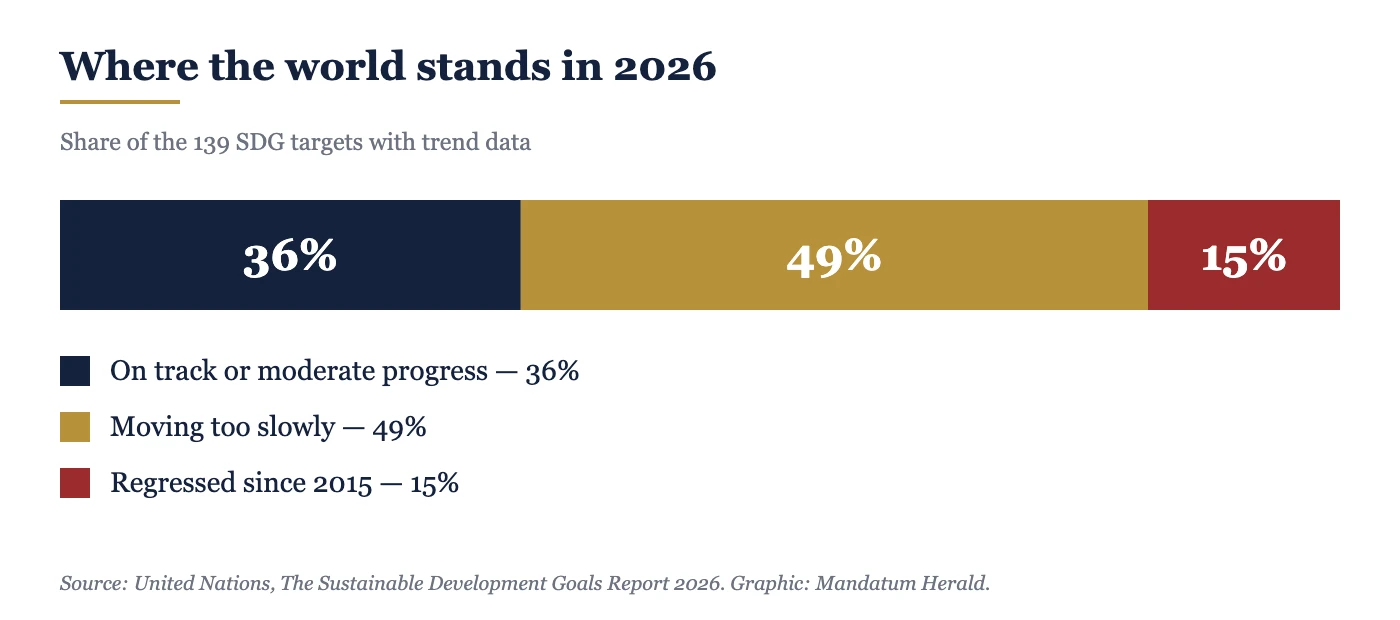
According to the United Nations' Sustainable Development Goals Report 2026, of the 139 targets with available trend data, just over a third are on track or making moderate progress, nearly half are moving too slowly and some have gone backwards since 2015. None of the gender equality targets is on track.
Progress of the SDG targets in 2026. Source: UN, The Sustainable Development Goals Report 2026. Graphic: Mandatum Herald.
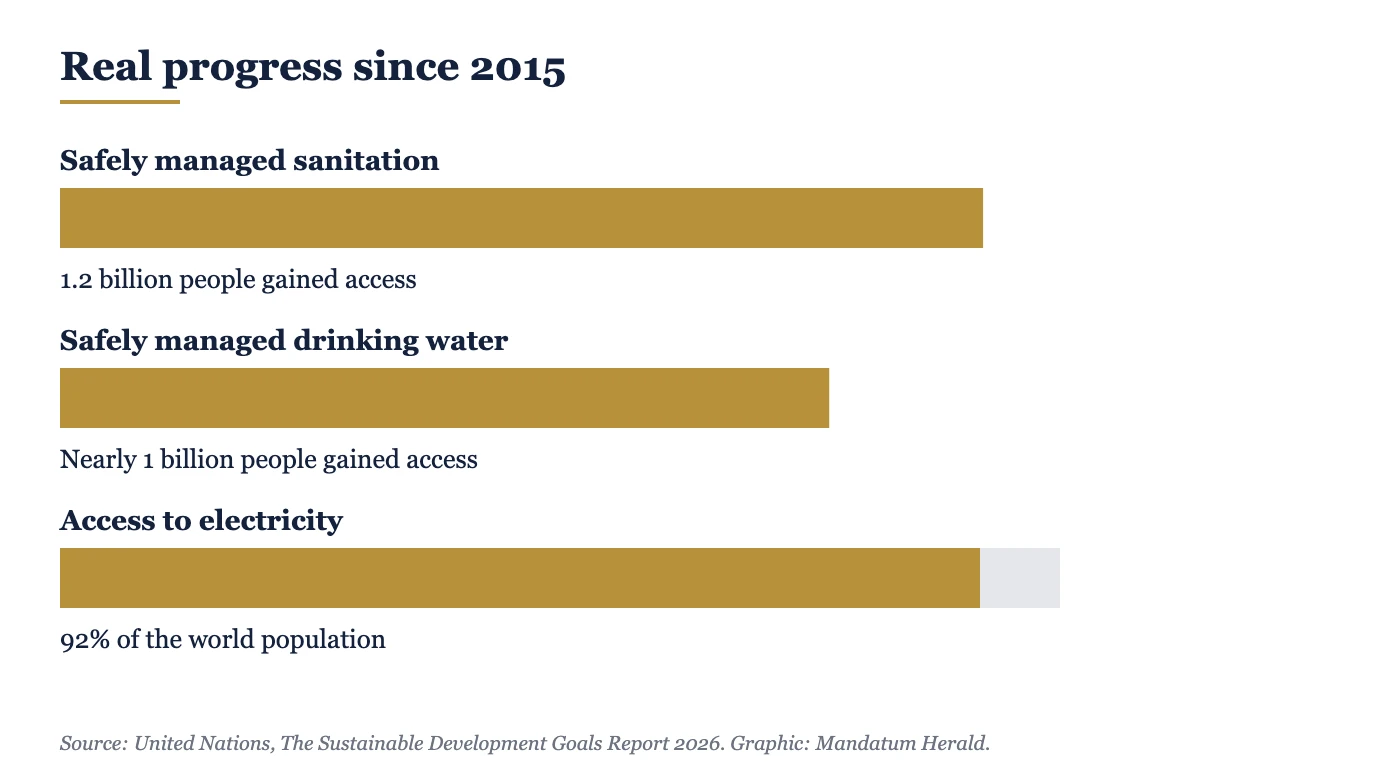
Yet the progress achieved is real. Since 2015, nearly one billion people have gained access to safely managed drinking water and 1.2 billion to safely managed sanitation. Electricity now reaches 92 per cent of the world's population, and for the first time social protection covers more than half of the global population. These results show that the goals are achievable when sustained investment, sound policies and international cooperation come together.
Progress achieved since 2015. Source: UN, The Sustainable Development Goals Report 2026. Graphic: Mandatum Herald.
The main obstacles are equally clear: armed conflicts, climate change, rising debt and falling development assistance. Closing the gap will require more financing, stronger institutions and, above all, cooperation between governments, organizations and citizens.
What each of us can do
Few of us lead governments, but all of us consume, work, save and vote. Everyday decisions are where personal action counts the most.
Choose one goal
Pick the goal that matters most to you; trying to cover all seventeen at once leads nowhere.
Change one habit this month
Reduce food waste, choose durable products, use public transport, or ask where your bank invests your money.
Join others
Offer your time and skills to an organization already working on that goal. As Goal 17 reminds us, no one achieves them alone.
The SDGs at Mandatum
The SDGs are also the framework that guides much of the humanitarian work of Mandatum. Each project of the Order is designed to contribute to concrete goals: decent and affordable housing and sustainable communities (Goal 11), health and well-being (Goal 3), education and training (Goal 4), decent work (Goal 8) and the protection of the environment (Goals 13 and 15), always in partnership with the communities and institutions it serves.
The 2030 Agenda is not a distant promise. It is a shared commitment, and it advances one decision at a time. Which goal will you start with?
Sources: United Nations, Transforming our World: the 2030 Agenda for Sustainable Development (2015); United Nations, The Sustainable Development Goals Report 2026. Cover photo: NASA, Apollo 17 (public domain).
 Barça
 Peñarol
 Inter Miami