
 Barça
 Peñarol
 Inter Miami
Pope Leo XIV is recovering from lung surgery in Rome and has not stopped working for peace: three days after the operation, from his hospital room, he phoned Russian President Vladimir Putin to ask for a ceasefire and help for civilians trapped in Ukraine.
According to the Holy See Press Office, he was expected to leave Gemelli hospital on the afternoon of Saturday, October 17, the fifth day of his stay, and return to the Vatican.
What happened
The Vatican announces that the Pope will undergo surgery for a nodular lesion in his lung.
Surgeons, among them Dr. Stefano Margaritora, head of thoracic surgery at Gemelli, remove the lower lobe of his right lung using a video-assisted technique. The operation lasts about 90 minutes.
Blood tests and a chest X-ray show a “normal postoperative course.”
From the hospital, the Pope speaks by phone with Putin.
Doctors Luigi Carbone and Stefano Margaritora discharge him after new tests and X-ray.
The examination performed during the operation confirmed a lung adenocarcinoma, as earlier studies had suggested, according to the Holy See. The Vatican described the surgery as successful and free of complications.
Recovery so far
The Pope began respiratory physiotherapy, walks around his room and is on a regular diet. Before leaving the hospital, he was to celebrate Mass in a room on the 10th floor.
Peace remains on his agenda
The Holy See Press Office reported the call in a note to accredited media and did not specify who initiated it. It is the second known conversation between the two men; the first was on June 4, 2025.
According to the Vatican, Leo expressed his “deep concern for the grave humanitarian situation” in Oleshky, a city in Ukraine’s Kherson region, and asked for a ceasefire “to allow the delivery of food and medical assistance, and the voluntary and safe evacuation of the civilian population” (our translation). He also reaffirmed the Holy See’s commitment to dialogue and peace.
Reported on October 5 some 2,000 people trapped, 40 of them children.
Estimates more than 6,000, including about 200 children. It had asked for the Pope’s intervention on September 19.
Reported on October 2 that no food had reached the city since May 26.
The Kremlin described the conversation as constructive and marked by mutual respect. It said Putin wished the Pope a speedy recovery, thanked him for his willingness to help resolve the conflict and supports the Vatican’s initiative to bring supplies to the civilians of Oleshky, a city controlled by Russia, and that “it was agreed to cooperate” on the matter. Moscow blamed the humanitarian situation on Kyiv, which in turn accuses Russia of using hunger as an instrument of coercion. No details of what was agreed have been released and, according to the Salt Lake Tribune, Russia has not accepted a safe evacuation corridor.
That same day, in his message for World Food Day, the Pope called regular access to food “a basic human right,” and Vatican Media released the first images of him since the surgery, celebrating Mass at Gemelli.
A consistent line
Elected; in his first Sunday message he calls for peace in Ukraine, a ceasefire in Gaza and the release of the hostages.
At the Regina Caeli he asks the parties to “cease fire and urgently seek a peaceful solution,” naming Ukraine, Lebanon and Sudan, and asks that civilians be protected.
Archbishop Paul Gallagher meets Foreign Minister Lavrov in Moscow: “this war must end.” Lavrov agrees to strengthen humanitarian cooperation; Gallagher mentions the upcoming mission of Cardinal Matteo Zuppi to Russia.
The concrete results remain uncertain: as the Salt Lake Tribune recalls, his earlier humanitarian appeals have often had little effect. But the call shows that, even while recovering from major surgery, the Pope keeps peace and aid for civilians at the center of his work.
What comes next
The Pope was scheduled to lead the Angelus on Sunday, October 18, from the window of the papal apartment, with all audiences suspended until October 20. The trip to South America scheduled for November 6 was in doubt at the time: Peru’s president said plans could change and that recovery would take “several weeks,” and air travel is generally avoided for about three weeks after this type of surgery.
What was still unknown
The Vatican had not published a prognosis or a follow-up treatment plan. Dr. David Jones of Memorial Sloan Kettering Cancer Center told CBS News that the pathology result was still to be known, including whether lymph nodes were involved and which molecular tests would guide any therapy. Cardinal Blase Cupich of Chicago said the diagnosis “is not the news we were hoping for.”
Update: by October 22, doctors had confirmed that the Pope is cancer-free, that the cancer was localized and completely removed, and that he needs no further treatment. He returned to his Wednesday audiences on October 21, and the November journey to Uruguay, Argentina and Peru has since been confirmed with its full itinerary.
Information as of October 17, 2026, based on Holy See statements and the press cited below.
Sources
- Vatican News: October 17 medical bulletin
- CBS News: diagnosis and surgery
- ABC News: recovery after surgery
- America Magazine: call with Putin
- National Catholic Reporter: call with Putin and Oleshky context
- Salt Lake Tribune: first images after surgery
- Vatican News: Gallagher in Moscow
- EWTN News: April 12 appeal
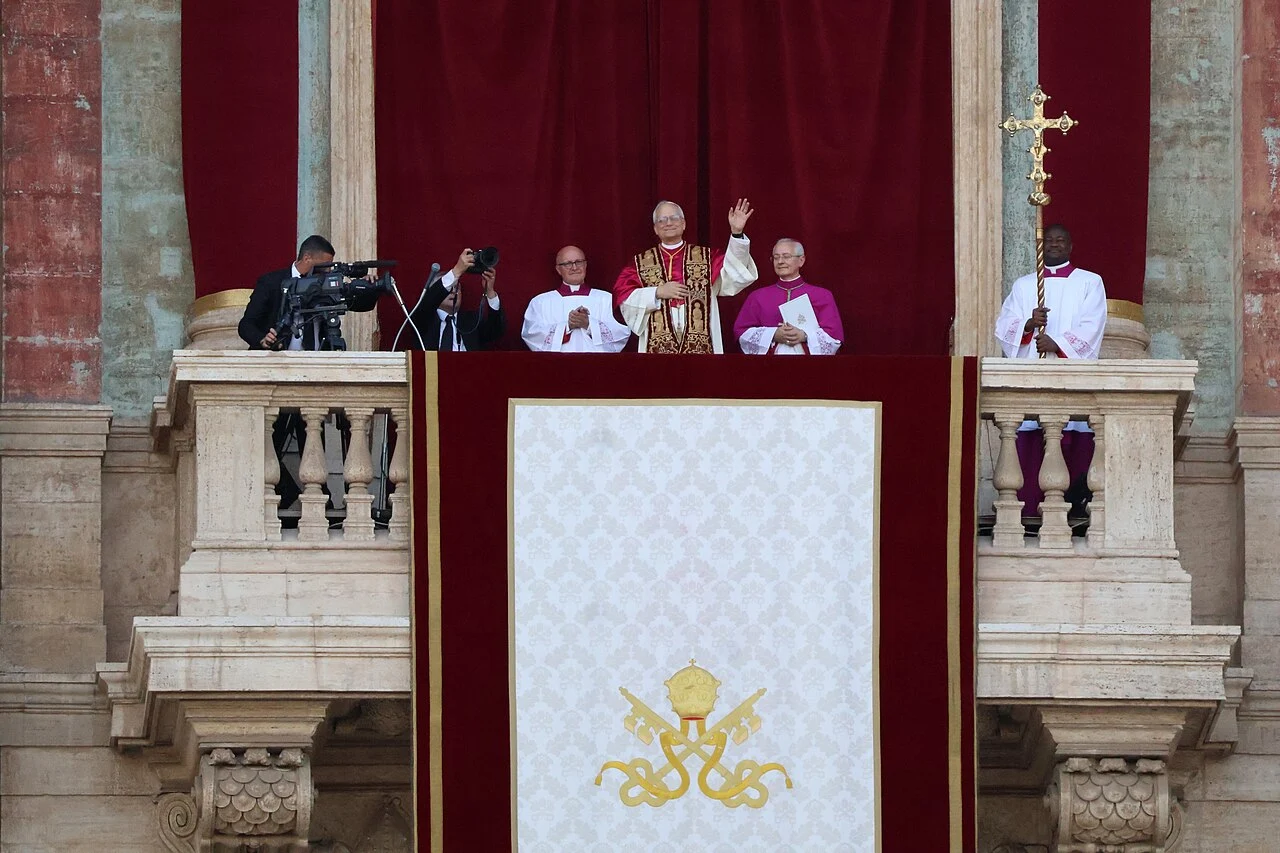
Photo: Pope Leo XIV on the loggia of St. Peter’s Basilica (file photo). Edgar Beltrán / The Pillar, via Wikimedia Commons, CC BY-SA 4.0.