 Barça
 Peñarol
 Inter Miami
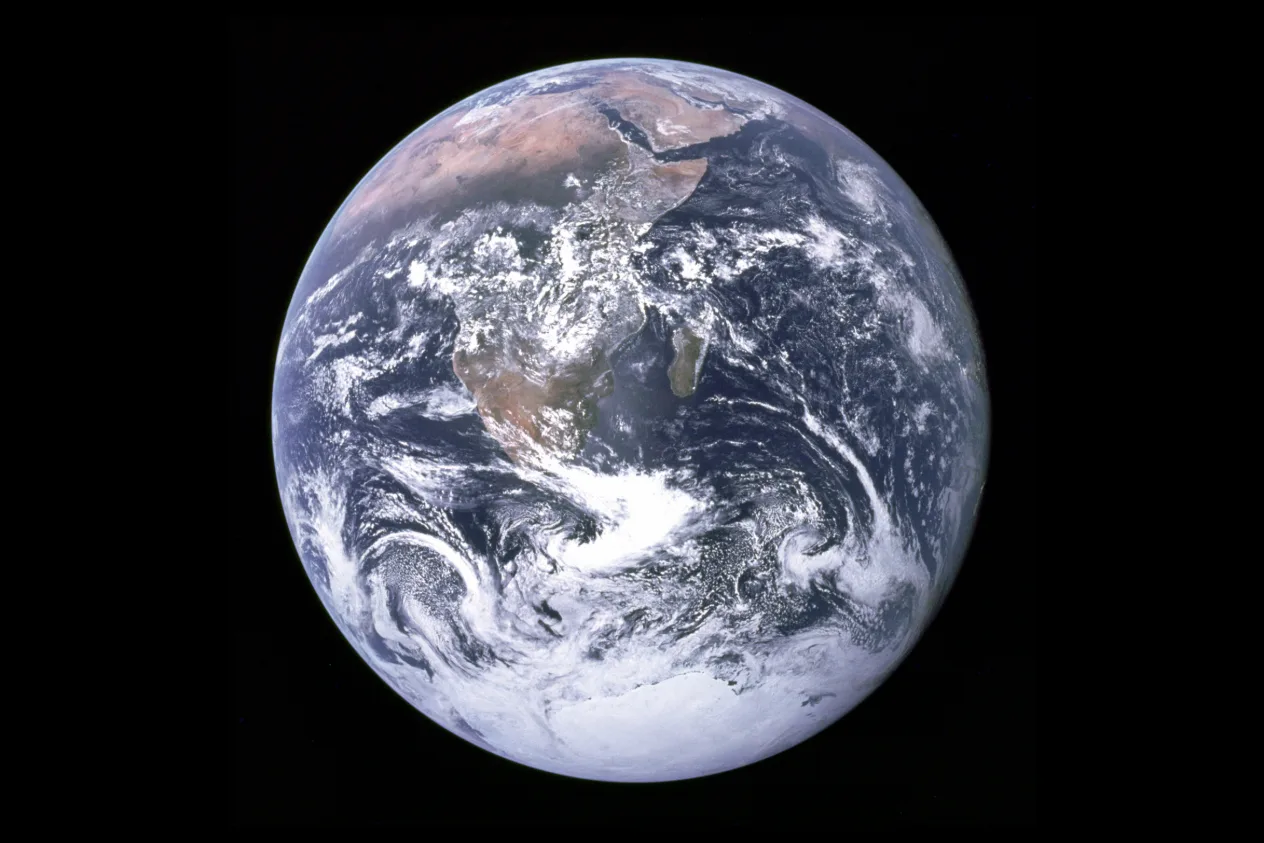
Seventeen goals, 169 targets and one deadline. This guide explains what the Sustainable Development Goals are, what each one seeks, and how far the world still has to go.
In September 2015, the 193 member states of the United Nations adopted the 2030 Agenda for Sustainable Development, a shared plan to end poverty, protect the planet and ensure that all people can live in peace and prosperity. At its heart are the Sustainable Development Goals, known as the SDGs: seventeen goals that, for the first time, apply to every country in the world, rich and developing alike.
Ten years on, with less than five years remaining, they are still the most complete roadmap humanity has agreed upon.
What the SDGs are
The SDGs replaced the Millennium Development Goals, which guided international efforts between 2000 and 2015 and focused mainly on developing countries. The new agenda is broader and universal. It holds that ending poverty must go hand in hand with strategies that build economic growth and address education, health, social protection and jobs, while tackling climate change and protecting the environment.
The central promise: leave no one behind. Each goal is broken down into specific targets, and each target is followed through measurable indicators. The goals say what must be achieved; the targets say how and how much.
Five dimensions, seventeen goals
The agenda is organized around five dimensions, known as the five Ps: people, planet, prosperity, peace and partnership. The chart shows how the seventeen goals are distributed among them.
The seventeen goals, group by group
Open each group to see what its goals seek and the key target behind each of them.
People · 5 goals
Ending poverty and hunger, and ensuring dignity, health, education and equality for every human being.
End poverty in all its forms everywhere.
Key target: Social protection floors for all, and equal rights to economic resources.End hunger, achieve food security and improved nutrition, and promote sustainable agriculture.
Key target: Sufficient, nutritious food all year round, and doubled productivity of small-scale producers.Ensure healthy lives and promote well-being at all ages.
Key target: Fewer than 70 maternal deaths per 100,000 live births; an end to preventable deaths of newborns and children under five; universal health coverage.Ensure inclusive and equitable quality education and lifelong learning opportunities.
Key target: Free, equitable and quality primary and secondary education for every girl and boy.Achieve gender equality and empower all women and girls.
Key target: An end to discrimination and violence, and full participation in political, economic and public life.Planet · 5 goals
Protecting the planet from degradation: water, sustainable consumption, climate, oceans and land.
Ensure availability and sustainable management of water and sanitation for all.
Key target: Universal access to safe drinking water, sanitation and hygiene.Ensure sustainable consumption and production patterns.
Key target: Halve per capita food waste and substantially reduce waste generation.Take urgent action to combat climate change and its impacts.
Key target: Strengthen resilience and adaptive capacity, and integrate climate measures into national policies.Conserve and sustainably use the oceans, seas and marine resources.
Key target: Reduce marine pollution and protect coastal and marine ecosystems.Protect, restore and promote sustainable use of terrestrial ecosystems, forests and biodiversity.
Key target: Halt deforestation, restore degraded land and stop the loss of biodiversity.Prosperity · 5 goals
Ensuring that all people can enjoy prosperous and fulfilling lives in harmony with nature.
Ensure access to affordable, reliable, sustainable and modern energy.
Key target: Universal access to modern energy and a substantially larger share of renewables.Promote sustained, inclusive growth, full employment and decent work for all.
Key target: Full and productive employment, an end to forced and child labour.Build resilient infrastructure, promote inclusive industrialization and foster innovation.
Key target: Reliable, sustainable infrastructure and universal access to information technology.Reduce inequality within and among countries.
Key target: Income growth of the poorest 40 per cent above the national average, and the social, economic and political inclusion of all.Make cities and human settlements inclusive, safe, resilient and sustainable.
Key target: Access to adequate, safe and affordable housing and basic services for all.Peace · 1 goal
Fostering peaceful, just and inclusive societies, free from fear and violence.
Promote peaceful and inclusive societies, access to justice for all and accountable institutions.
Key target: Significantly reduce violence, and ensure legal identity and public access to information.Partnership · 1 goal
Mobilizing the means to implement the agenda through a revitalized global solidarity.
Strengthen the means of implementation and revitalize the global partnership.
Key target: Mobilize financial resources, share technology and build statistical capacity.A system of connected goals
The goals cannot be achieved in isolation. Decent housing improves health; education opens the way to decent work; clean energy reduces pollution and protects the climate; peace and strong institutions make every other investment possible. Progress in one goal strengthens the others, and setbacks in one weaken the rest.
This is why the agenda asks governments, companies and organizations to design policies and projects that serve several goals at once. A well-planned housing project, for example, can contribute at the same time to health, water and sanitation, energy, employment and sustainable cities.
How progress is measured
Every year, the United Nations publishes a progress report based on data from national statistical offices and international agencies. Countries also present voluntary national reviews at the High-Level Political Forum in New York, sharing their results, difficulties and good practices.
Where the world stands today
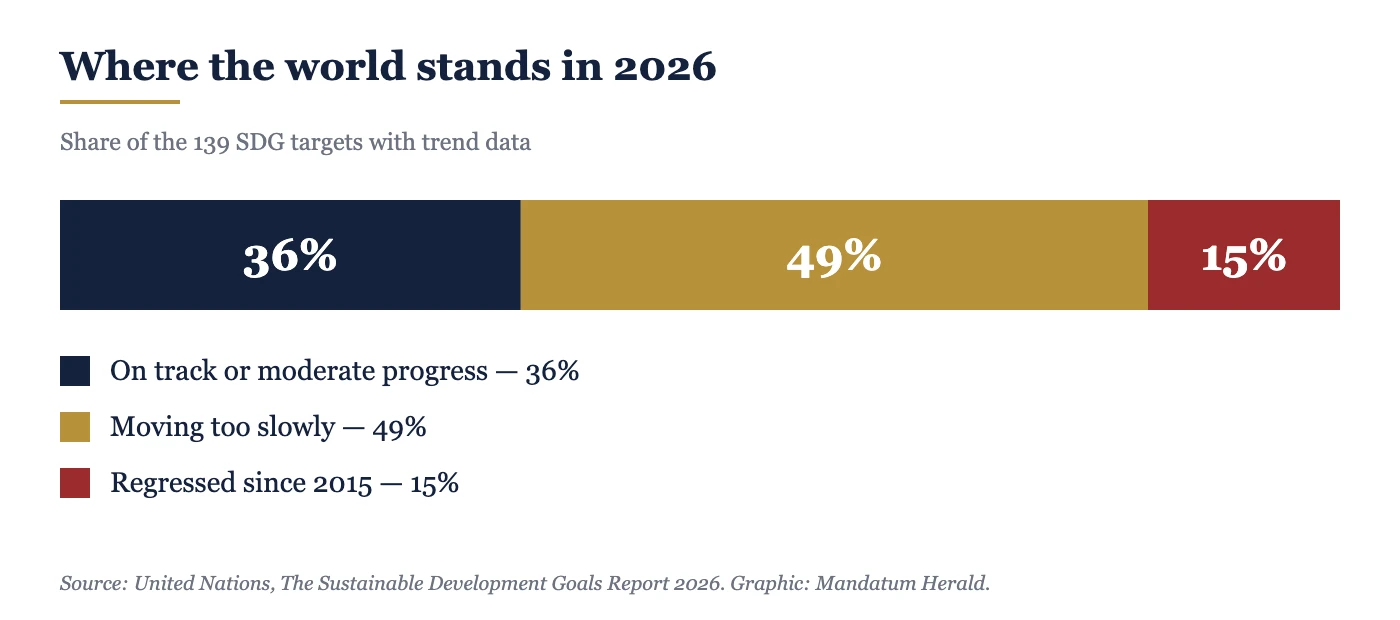
According to the United Nations' Sustainable Development Goals Report 2026, of the 139 targets with available trend data, just over a third are on track or making moderate progress, nearly half are moving too slowly and some have gone backwards since 2015. None of the gender equality targets is on track.
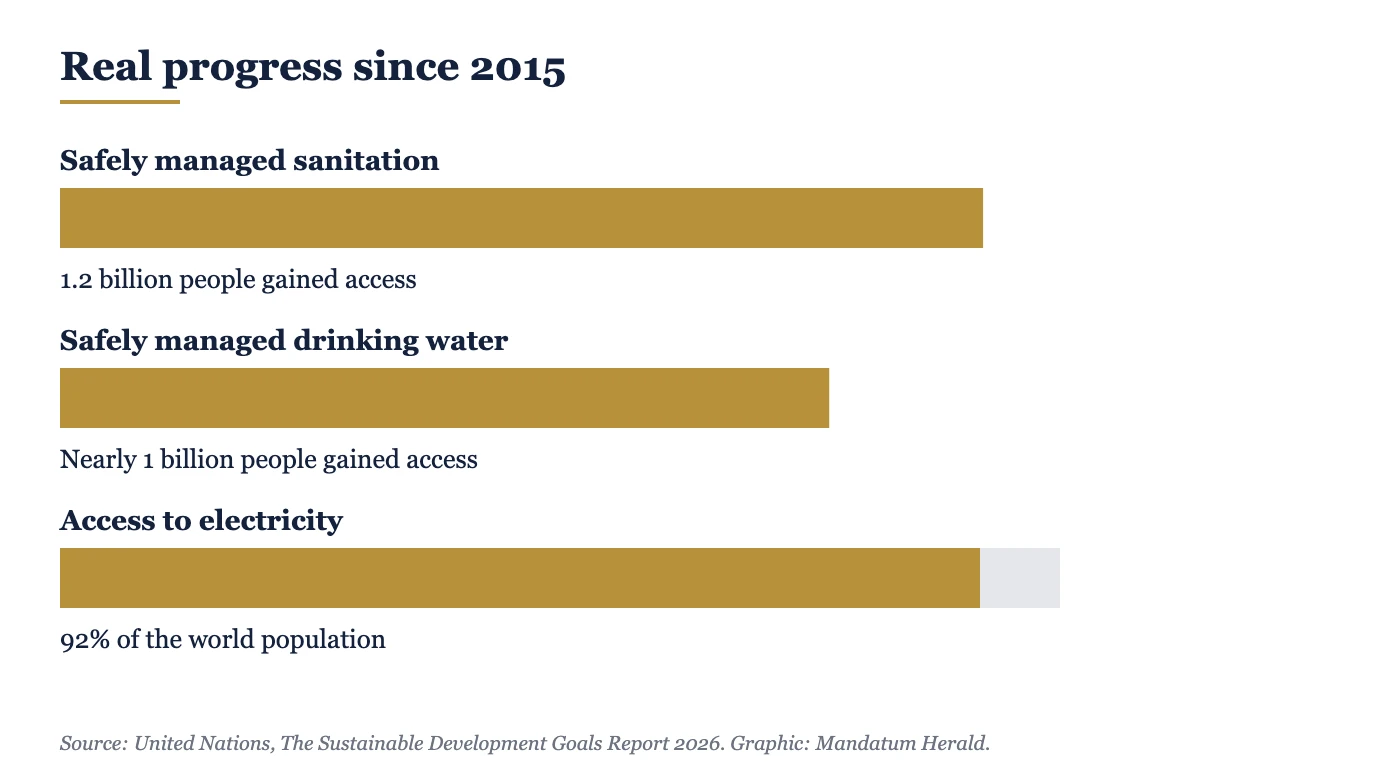
Yet the progress achieved is real. Since 2015, nearly one billion people have gained access to safely managed drinking water and 1.2 billion to safely managed sanitation. Electricity now reaches 92 per cent of the world's population, and for the first time social protection covers more than half of the global population. These results show that the goals are achievable when sustained investment, sound policies and international cooperation come together.
The main obstacles are equally clear: armed conflicts, climate change, rising debt and falling development assistance. Closing the gap will require more financing, stronger institutions and, above all, cooperation between governments, organizations and citizens.
What each of us can do
Few of us lead governments, but all of us consume, work, save and vote. Everyday decisions are where personal action counts the most.
Pick the goal that matters most to you; trying to cover all seventeen at once leads nowhere.
Reduce food waste, choose durable products, use public transport, or ask where your bank invests your money.
Offer your time and skills to an organization already working on that goal. As Goal 17 reminds us, no one achieves them alone.
The SDGs at Mandatum
The SDGs are also the framework that guides much of the humanitarian work of Mandatum. Each project of the Order is designed to contribute to concrete goals: decent and affordable housing and sustainable communities (Goal 11), health and well-being (Goal 3), education and training (Goal 4), decent work (Goal 8) and the protection of the environment (Goals 13 and 15), always in partnership with the communities and institutions it serves.
The 2030 Agenda is not a distant promise. It is a shared commitment, and it advances one decision at a time. Which goal will you start with?
Sources: United Nations, Transforming our World: the 2030 Agenda for Sustainable Development (2015); United Nations, The Sustainable Development Goals Report 2026. Cover photo: NASA, Apollo 17 (public domain).